Monday, February 22, 2016

Big Drop in Cancer-Causing HPV Following Vaccination, But Rates of Vaccination in US Lag

by Hank Dart

Thirteen years ago, in an earlier incarnation of Cancer News in Context, we wrote our very first post about the potential of the HPV vaccine following the release of a promising study in the New England Journal of Medicine. That post - "A Shot in the Arm for Cervical Cancer Prevention" -  concluded:
"While much work remains before there is any sort of widespread cervical cancer vaccination program in the U.S. or abroad, the results of this initial study spawn a realistic hope that over the next decade or so great strides will be made in preventing cervical cancer the world over."
Well here we are, that decade or so on from the original post, and the latest news on the HPV vaccine - as reported in today's New York Times - is quite positive, but with a number of important caveats.

HPV (human papillomavirus) is a common sexually transmitted infection, and certain types of HPV are a primary cause of cervical cancer. It's estimated that nearly all adults - men and women - are infected with HPV at some point in their lives. While the body naturally clears most of these infections, some can persist, increasing the risk of cervical (and a number of other) cancers.

New national data, as reported in the Times and published in the journal Pediatrics today, show that in the six years after 2006, when the HPV vaccine became available for girls, rates of infection with four main cancer-causing types of HPV(6, 11, 16, and 18) have dropped dramatically - as much as 64 percent in younger females (age 14 - 19), the age group that had been the most widely vaccinated.

Though only time, and data, will tell for sure, such findings seem likely to translate to significantly lower future rates of cervical cancer in today's groups of vaccinated girls and young women.

Alongside such positive news, however, is the fact that the HPV vaccine remains frustratingly underused in the United States.  As we wrote about in 2014, vaccination rates for the HPV vaccine are much below those of other childhood vaccines.  The most recent numbers show that only 38 percent of girls in the United States receive the complete 3-shot series of the HPV vaccine.  Boys' numbers are even lower - at 14 percent.  And low as these are, they are modest improvements from pervious years.

In comparison, in Australia, where the vaccine is offered for free at schools as part of its national immunization program, rates of full 3-dose HPV vaccination in girls is over 70 percent by age 15.

No such integration into systems has happened in the United States, and HPV vaccination remains in many ways on the fringe.  Though it has huge potential to prevent cervical cancer - as well as to lower the risk of anal, throat, and penis cancers, as well as genital warts - many physicians aren't proactive in suggesting vaccination, many parents don't know to request it,  and both groups may not be perfectly clear on its safety, effectiveness, and ultimate purpose of preventing cancer.

Clearly, there has been a lot of progress since our post in 2003 but perhaps not surprisingly it has been at a pace slower than hoped.  To be sure, there have been some "great strides" in further developing the vaccine, in documenting its safety and effectiveness, and - in certain countries - developing model vaccination programs.

But there is still a great deal of work to do before we tap the HPV vaccine's full potential in the United States - as well as worldwide.  This latest study shows the likely benefits of developing a better-integrated HPV vaccination program.  Let's use it to spur on coordinated efforts toward that important end.

Tuesday, February 16, 2016

Taking Steps to Stay Healthy After Cancer (Infographic)

by Katy Henke

Whether you have just been diagnosed, are going through treatment, or are post-treatment, it’s almost never too early to start thinking about your health after cancer. With the help of your doctor, these 8 "ways" can be your guide. Begin with one or two and work your way toward accomplishing each. Your only limitation, really, is when you want to start!  See full details for each, here.

https://siteman.wustl.edu/prevention/take-proactive-control/8-ways-to-stay-healthy-after-cancer/

Wednesday, February 10, 2016

Help Protect Kids from Cancer: Support a Ban on Youth Indoor Tanning

by Hank Dart

We've written a great deal in CNiC over the years on the dangers of indoor tanning, with one primary theme being the allure it has to young people, especially teenage girls.  It even seems to border on an addiction of sorts, as some research suggests

With UV exposure in youth and young adulthood a key contributor to later adult risk of skin cancer - including deadly melanoma - it's important to limit such exposure during the early years of life.

A new rule from the Food and Drug Administration (FDA) proposes to protect youth from UV exposure from tanning beds by banning their use by minors under age 18.  Some states already have this restriction in place.  This rule would expand it nationwide, helping to protect all kids across the country.   

See the infographic below for more details, and click to support this proposed rule by leaving a comment on the FDA website by March 21, 2016. 

Tuesday, February 2, 2016

New Study Finds High Fiber Diet Early in Life Lowers Breast Cancer Risk


by Hank Dart

Though coverage of the Iowa caucuses has eclipsed most other media stories this week, there was still some important health news Monday about a large study finding that a high-fiber diet early in life may lower the risk of later adult breast cancer.

The study, part of the long-running Nurses' Health Study II, included over 44,000 adult women who were followed for 20 years and provided details on what they ate both in their early adults years and during high school.  Fiber intake in both periods of life were found to have an important impact on breast cancer risk, particularly for cancer that develops before menopause.

Women who ate the most fiber as adolescents (around 29 grams/day) had a 24 percent lower risk of premenopausal breast cancer compared to women who ate the least fiber as adolescents (around 18 grams/day).  For fiber intake in the early adults years, the findings were nearly identical, with those eating the most (around 26 grams/day) having a 23 percent lower risk of premenopausal breast cancer than those eating the least (around 12 grams/day).  And for every 10 grams per day of fiber the women ate in early adulthood or adolescence, the risk of overall breast cancer (premenopausal and postmenopausal combined) dropped by 13 or 14 percent, respectively.

Three pieces of 100 percent whole wheat bread has around 10 grams of fiber.

As we've written about previously here in CNiC, and in our new ebook TOGETHER - Every Woman's Guide to Preventing Breast Cancer, more and more evidence points to youth and the young adults years as key to lifelong breast health. And these current findings build on previous results suggesting that plant-based diets high in fiber can reduce breast cancer risk.

For parents looking to help their daughters make food choices that can help lay a foundation for lifelong breast health, there are some simple steps.  Help them focus on fruits, vegetables, nuts, and whole grains, while limiting full-fat dairy and meat -- and avoiding alcohol (more). Also key is healthy growth, helping them develop lasting eating and activity habits that help them maintain a healthy weight throughout life (more).  

We know that half of all breast caners can be prevented by steps most women can take.  This new study further confirms that lifestyle choices can have an important impact on breast cancer risk and that a cancer prevention lifestyle can almost never begin too early.

Friday, January 29, 2016

Weighing Evidence: Obesity and Breast Cancer Risk Across Life


by Hank Dart

In a paper published yesterday in the journal Science Translational Medicine, Cancer News in Context's Graham Colditz and Washington University researcher, Kelle Moley, detail the important role that overweight and obesity play in the development of breast cancer.

Looking at wide-ranging evidence at all periods of life -- from gestation to the years after menopause -- Colditz and Moley show that despite some targeted times in youth, excess weight increases breast cancer risk over the course of a woman's life.
In the womb.  Though there is still a great deal to learn about the impact of mother's weight on her daughter's adult risk of breast cancer, larger weight gain during pregnancy has been linked with a higher risk of breast cancer in daughters.  The more a daughter weighs at birth has also been found to increase risk.   
Infancy and childhood.  Overweight in this period of life likely has a mixed impact on adult breast cancer risk.  It can lower breast density as well as slow the rate that girls grow to their maximum height -- each of which can reduce breast cancer risk.  At the same time, being overweight in childhood can lead to earlier first periods (menarche), which is an important breast cancer risk factor. 
Adolescence.  The lower risks linked to childhood overweight likely continue through the adolescent years.  
Premenopause.  While the protection against breast cancer from youth overweight likely persist, adult weight gain in the years before menopause can increase risk, offsetting and likely surpassing protection from youth. 
Postmenopause.  Evidence has long-shown that overweight and weight gain after menopause increases the risk of breast cancer.  
Though there are a number of possible reasons why overweight influences breast cancer risk, it's impact on hormone levels and related responses at various stages of life is a major part.

Despite some periods in life where overweight may have a beneficial effect on breast cancer risk, its overall impact is certainly negative.  And the best approach is to maintain a healthy weight throughout life - from childhood on.   Weight often tracks children and adults throughout life.  Overweight youth are more likely to become overweight adults, and overweight young adults are more likely to be overweight in later life.

For adults who are overweight, though, there is good evidence that losing weight and keeping it off can significantly lower breast cancer risk as well as the risk of other important diseases, like heart disease and diabetes.

Here in Cancer News in Context, we've previously highlighted some straightforward -- and a few off-kilter -- tips for keeping weight in check, most recently during our series, 9 Days of Practical Steps to Prevent Breast Cancer. Perhaps less familiar for many is knowing how best to approach weight and breast health issues of their children.  The focus should be on helping children be active, eat a largely plant-based diet, and avoid tobacco and alcohol.  Hardest for many parents is simply recognizing if their child has a weight issue -- so making an effort to understand where their child falls on growth charts can be really important in helping them maintain a healthy weight in their youth, and beyond. A good place to start for questions about childhood weight is the CDC’s BMI Calculator for Child and Teen. For more on breast health approaches for youth, see The Power of Youth: Beginning Breast Cancer Prevention in Childhood.

Monday, December 28, 2015

2015's Top Posts on Cancer News in Context

It's been another big year of cancer prevention news, and it started with a real splash way back in January with a headline-grabbing study in Science attributing most cases of cancer to simple "bad luck." Not surprisingly, we disagreed with that conclusion, and our post responding to the study - and the stories it generated - was one of the most popular on Cancer News in Context in 2015. Other popular posts ran the gamut of topics: from links between sugary sodas and earlier periods; to risk-reducing diet tips; to the on-going problem of tanning bed use by youth and young adults. 
As we get set for another eventful year, here are our top 5 posts from 2015, in order of popularity:
-   -   -   -

February 3, 2015

Study Finds Periods Start Earlier in Girls Who Drink a Lot of Sugary Drinks. What Does This Mean for Breast Cancer Risk? 

A new study released last week in the journal Human Reproduction has found that regularly drinking sugar-sweetened beverages - like sodas and fruit drinks - may cause girls to start their menstrual periods at earlier ages.

The study, a spin off of the long-running Nurses' Health Study at Harvard University, followed around 5,000 9 - 14 year old girls for up to five years - tracking their food, beverage intake, and menstrual status along the way.  Researchers found a distinct link between regularly drinking sugary beverages and the age periods started (technically called, menarche).  Those girls who drank more than 1.5 servings of soda or fruit drink each day started their period on average at 12.8 years, about three months earlier than girls drinking 2 or fewer servings each week. Even after taking body mass index (BMI) into account, which is linked to age at menarche,  the same general association remained.

So, what does this have to do with cancer?

There's increasingly good data that early life plays a particularly important role in later adult breast cancer risk, something we've certainly written about here on CNiC.  This new study provides further evidence....

>>continue reading 

Photo: Creative Commons Lic. (cropped): Flickr/zingersbs


January 8, 2015

Setting the Record Straight on Cancer Prevention: Lifestyle Trumps "Bad Luck" 

It's been hard to avoid the headlines this past week touting the conclusions of a new study in the journal Science that cancer is a disease largely caused by "bad luck."  Some of these headlines have been sensationalized; some have been more measured.  Together, they've seemed nearly ubiquitous.  And in some ways that's been positive, demonstrating that cancer - and its causes and prevention - remain an important topic to both the public and the media.


Unfortunately, the conclusions of the paper - and the subsequent coverage they've received - seem to reach well beyond what the actually findings of the study support, and in doing so, have incorrectly called into question what decades of overwhelming evidence shows:  that over half of all cancers - and up to three quarters of some cancers - could be prevented by regular screening and healthy lifestyle choices.

The new study by Johns Hopkins researchers Cristian Tomasetti and Bert Vogelstein gathered data on the number of stem cell divisions that occur in various tissues in the body and compared these data to annual incidence rates of cancers in those tissues.  Stem cells divide to replace cells in tissue that die or are lost.  This maintains the tissue.  Some tissues need a lot of cell divisions for maintenance.  Others need less.  When cells divide, the DNA in cells also replicate and divide, opening up the chance for random mutations that could eventually lead to cancer.

The researchers found a strong correlation between tissues' number of stem cell divisions and cancer in those tissues, attributing 65% of cancers to these divisions, and the random DNA mutations that can occur with them.

While the study is well-designed and executed, it also has...

>>continue reading 


August 31, 2015

Bottom Line of New Study: Colon Cancer is Quite Preventable

A large proportion of colon cancer is preventable with healthy lifestyle choices, even without taking into account the benefits of screening.  That's the finding in a new analysis from the large Nurses' Health Study released in print last week in Cancer Causes & Control.  The analysis, done by researchers from Stanford and Harvard Universities, calculated the percentage of colon cancers in women that could be attributable to a combination of lifestyle choices that have been found in previous research to be established risk factors for the disease: overweight/obesity, lack of physical activity, alcohol intake, smoking, low multivitamin use, and low calcium intake.

Comparing women who had only one or none of these risk factors with women having two or more, the researchers found that 37 percent of colon cancer cases in women could be avoided through healthy lifestyle choices.  This proportion was even higher when aspirin use was considered.  Though not a lifestyle choice, per se, long term aspirin use has been shown in many well-designed studies to lower the risk of colon cancer.  When aspirin use of just twice a week for six years or more was added to the analysis, the percentage of cancers estimated as preventable rose to 43 percent.

These percentages are quite significant and do not even take into account the further benefit of colon cancer screening, which in addition to catching cancer early can also prevent the disease by finding (and removing) pre-cancerous growths.

Though some other analyses have estimated...

>>continue reading
Photo: Creative Commons Lic. Flickr/thomasletholsen


January 12, 2015

Preventing Skin Cancer: Tanning Beds Still Alluring, Still Very Risky


There was a nice piece in the New York Times this weekend on the risks of indoor tanning, particularly in youth. Focussing on the personal experiences of a handful of young women and their  parents, it does a very good job highlighting the well-established risks of skin cancer and deadly melanoma, the continued allure of tanning, and some promising advances in tanning salon regulation and rates of tanning by youth.

We've written a number of posts over the years here on Cancer New in Context (see below) about the dangers of tanning beds and the need for better policies to curb their use and protect youth. So, it's good to see the topic continuing to gain traction both in terms of awareness and in the willingness of state and federal government to take important tax and regulatory action to try to maintain the recent downward trend in tanning bed use.
In many ways, it's similar to the concerted efforts that have helped curb tobacco use over the past 50 years, a similarity not lost on 22 year-old Westfield State University student, Elizabeth LaBak, who was highlighted in the Times article:
“The tanning thing is like the smoking thing,” she said. “Everyone used to smoke. And then they said, ‘You’ll die of lung cancer.’ That’s what’s happening to tanning.”
As this quote sums up...

>>continue reading
Photo: Creative Commons Lic. Flickr/whatshername


September 17, 2015

Eating to Lower Cancer Risk: Replacing Superfoods with Science

by Graham Colditz, MD, DrPH

Article originally appeared in the Washington University - Institute for Public Health Blog

When it comes to cancer, there are few topics as supercharged as diet. A quick search of “diet and cancer” in Google News alone returns over 3 million stories. And yet, however large these numbers are, they don’t fully capture the passion that many people feel about the food/cancer link. There’s something special, elemental even, about making sure the food we eat is as safe and as healthy as possible – for us and for our loved ones.

Yet, however motivated people are to make healthy food choices, there are a lot of mixed signals out there on what to eat to lower cancer risk. Magazines and websites often tout “superfoods” and “cancer-busters” that rarely match up with official eating recommendations, and even these official recommendations seem to change month to month with the release of new – and often seemingly contradictory – study results.

Trying to decide what to eat can be an exercise in frustration, a sentiment captured perfectly in findings from a 2007 paper on public beliefs about cancer prevention. In this national sample survey, over 70 percent of respondents agreed with the statement that “there were so many recommendations about preventing cancer that it’s hard to know which ones to follow” (1).

The reality, though, is that when all the evidence on the links between diet and cancer are looked at together, clear and simple messages rise to the surface. These messages contain no “superfoods” or “cancer-busters” and, so, may not always lead the headlines. But what they may lack in headline-grabbing flash, they more than make up for by being recommendations based in solid science. And that’s really what matters.

Watch the calories
We see them listed everywhere and so have become inured to them in a way, but calories really matter when it comes to cancer risk. In fact, they’re probably the single most important aspect of diet when it comes to preventing cancer. Consistently eating too much can lead to weight problems. And, among other health risks, obesity is an established risk factor for at least eight different cancers and is responsible for 120,000 cases each year in the United States (2,3).

Over two-thirds of the nation is either overweight (BMI 25 – 29.9) or obese (BMI 30 or over), and studies consistently demonstrate that people have difficulty recognizing if they – or their children – are an unhealthy weight. Add to this the increasingly sedentary lifestyles that go along with modern society, and it takes a concerted effort by most people to moderate calories and keep weight in check over the course of their lives (4). These simple tips can help keep calories and weight in control:
  • Avoid sugary drinks, like sodas, energy drinks, and sports drinks. Even 100% juice should be kept to small amounts each day.
  • Focus on eating mostly plant-based foods, like whole grains, fruits, and vegetables. 
  • Be a more mindful eater. Start with smaller portions, eat slowly, and try to eat only when truly hungry. 
  • Fit physical activity into each day. More is almost always better, but any amount is better than none. 
  • Weigh your self on most days. It’s easy, keeps surprise weight gain at bay, and helps you make diet/activity adjustments in a timely manner.

Limit food from animals 
You don’t need to go full vegetarian – unless you want to – but there’s compelling data that eating fewer animal-based foods can lower the risk of colon cancer, prostate cancer, and possibly breast cancer (5-7). Try to eat fewer than three servings of red or processed meat each week, and choose more plant-based sources of protein and fat, like nuts, beans, and vegetables.  
Focus on fruits, vegetables, and whole grains 
The data linking fruits and vegetables as a whole with lower cancer risk...

>>continue reading
Photo: Creative Commons Lic. Flickr/Colin Brace

Thursday, December 17, 2015

A Closer Look at Obesity, Breast Cancer, and Health Disparities

by Graham Colditz, MD, DrPH

Obesity is an established cause of postmenopausal breast cancer, with the International Agency for Research on Cancer (IARC) estimating that approximately 10 percent of postmenopausal breast cancer is due to excess weight (1). Overweight and obesity also increase the risk of mortality after diagnosis. One large analysis combining data from some 82 studies found that women who were obese in the months before being diagnosed had around a 40 percent higher risk of breast cancer mortality and total mortality compared to normal weight women (see Figure 1) (2).
Figure 1

Weight gain

Most women who are overweight or obese gain their weight predominantly in the adult years. We assessed the relation between adult weight gain and postmenopausal breast cancer after 26 years of follow-up in participants in the Nurse’s Health Study (3). Women who gained 22 pounds or more after menopause experienced an approximately 20 percent greater risk of breast cancer than women who maintained their weight after menopause. We also observed that weight gain of 5 pounds or more from age 18 on accounted for 15 percent of all postmenopausal breast cancer.

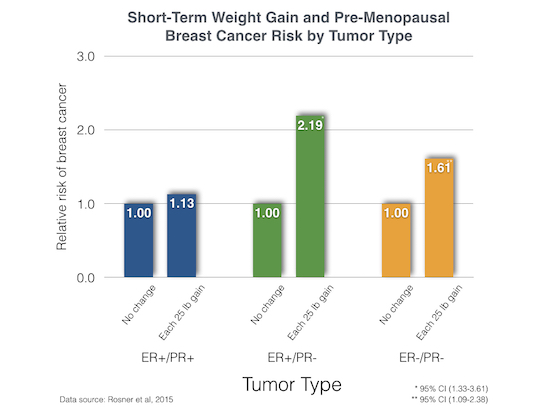
Though substantial weight gain is often something that happens over a relatively prolonged period, in the Nurses’ Health Study, we also assessed the potential impact of short-term recent weight gain on breast cancer risk (4). We looked at weight gain over 4 years, and the risk of cancer in the next 2 years. We found that short term weight gain increased the risk of premenopausal breast cancer, and that these risks were significant for two specific types of disease: ER+/PR- breast cancer and ER-/PR- breast cancer (see Figure 2). Compared to women who didn’t gain weight, the risk of ER+/PR- breast cancer was more than doubled with each 25 pounds gained over that period.

Figure 2

Why does this matter? Substantial weight gain in premenopausal years increases the risk of hard to treat breast cancer, such as ER-/PR- disease, and also conveys future cancer risk as women pass through into the postmenopausal years 4. While weight loss after menopause can substantially reduce breast cancer risk, perhaps by up to a half (see Figure 3) (3), avoiding weight gain is clearly preferable. Weight, once put on, can be hard to lose, and maintaining a lifelong healthy weight has the added benefits of improving quality of life and lowering the risk of many other cancers as well as other serious diseases, like diabetes, heart disease, stroke, and osteoporosis (5).
Figure 3

Prevalence and disparities in weight status

Weight gain, unfortunately, is a very common problem in the United States, and it is not one borne equally across society (6). While black and white boys show similar weight distribution from ages 5 to 17, black and white girls differ in weight starting around age 9, with black girls on average heavier than white girls. This difference continues to increase through age 17.

Weight gain through childhood and adolescence may reflect external circumstances – which can include factors like affordability of healthy food choices, availability of safe places to play/exercise, exposure to marketing of unhealthy foods, and parent/guardian time-constraints (7,8).

And many of the disparities in weight distributions in youth – and the social and physical environmental factors that help contribute to them – continue through the adult years.

Our recent analysis of national United States data (National Health and Nutrition Examination Survey) shows that African American women have had an overall higher prevalence of overweight and obesity compared to non-Hispanic white women over the past 20 years (see Figure 4) (9). The data also show that the prevalence of overweight and obesity in African American women exceeds that of non-Hispanic white women when looking at adults under age 50 and age 50 and over (see Figure 5). To be heavier as a group before age 50 implies continuing excess weight gain through the premenopausal years.

Figure 4 - Overall changes in weight status over the past 20 years. Source: Yang and Colditz, 2015

Figure 5 - Weight status by age – under age 50, age 50 and over. Source: Yang and Colditz, 2015

In a recent paper in the American Society of Clinical Oncology’s ASCO Post , I wrote about the excess rate of hard to treat breast cancers in African American women and that such hard to treat tumors are one likely reason that African American women experience higher rates of breast cancer mortality than do non-Hispanic white women. And growing data, already discussed, suggest that unhealthy weight may be a contributor to the risk for such hard to treat cancers.

So, while overweight is a key driver of breast cancer risk and poorer outcomes for all women, particular emphasis is needed on efforts that narrow the weight status and health disparities seen between races and ethnicities, improving outcomes across the board.

To successfully tackle the issue of overweight in such a way will require political will and multidisciplinary efforts that are focused not just on individual behaviors but also on the important physical, social, and healthcare environments that can be key barriers to or facilitators of individual actions on diet and physical activity.

It is a tall order but one certain to pay off many times over.


References

1. International Agency for Research on Cancer. Weight Control and Physical Activity. Vol 6. Lyon: International Agency for Research on Cancer; 2002.

2. Chan DS, Vieira AR, Aune D, et al. Body mass index and survival in women with breast cancer-systematic literature review and meta-analysis of 82 follow-up studies. Ann Oncol. 2014.

3. Eliassen AH, Colditz GA, Rosner B, Willett WC, Hankinson SE. Adult weight change and risk of postmenopausal breast cancer. JAMA. 2006;296(2):193-201.

4. Rosner B, Eliassen AH, Toriola AT, et al. Short-term weight gain and breast cancer risk by hormone receptor classification among pre- and postmenopausal women. Breast Cancer Res Treat. 2015;150(3):643-653.

5. Willett WC, Dietz WH, Colditz GA. Guidelines for healthy weight. The New England journal of medicine. 1999;341(6):427-434.

6. Rosner B, Prineas R, Loggie J, Daniels SR. Percentiles for body mass index in U.S. children 5 to 17 years of age. J Pediatr. 1998;132(2):211-222.

7. Swinburn BA, Sacks G, Hall KD, et al. The global obesity pandemic: shaped by global drivers and local environments. Lancet. 2011;378(9793):804-814.

8. Blumenthal SJ, Hoffnagle EE, Leung CW, et al. Strategies to improve the dietary quality of Supplemental Nutrition Assistance Program (SNAP) beneficiaries: an assessment of stakeholder opinions. Public Health Nutr. 2014;17(12):2824-2833.

9. Yang L, Colditz GA. Prevalence of Overweight and Obesity in the United States, 2007-2012. JAMA Intern Med. 2015.