Showing posts with label prevention. Show all posts

Wednesday, December 19, 2018

Take Time for Your Health During the Holidays


The holidays are here, and that means a calendar filled with family, friends and festivities. And as wonderful as that can be, it can also make it challenging to stick to the regular routines that help keep us healthy.

To help you have the physical and mental freshness to fully enjoy the season, try these three simple tips for looking after your own health over the holidays.

Say “No” – Sometimes

Parties and get-togethers can pack the short six weeks between Thanksgiving and New Year’s. And while that is certainly a great thing, giving us a chance to connect and celebrate with others during the season, it can also be tiring and maybe even a bit overwhelming. When that’s the case, it may be time to start saying “no, thank you” to some invitations. Take time for yourself to re-charge so you can be that much more excited about the next event. And, don’t worry, Aunt Marge will forgive you for missing her afternoon eggnog and sing-along party.

Move Your Body Every Day – At Least a Little Bit

It’s hard to overestimate the overall health benefits of regular physical activity. Plus, the boost in mood it provides can be just what we need during the jam-packed and at-times stressful holiday season. Yet, when they’re presents to wrap, cards to write and food to buy, exercise is often the first thing we let slide. So, it’s all the more important that you make it a priority. Gift yourself the time to fit in a workout, even it’s just a short one. Try a 15-minute walk with your sister to the grocery store, a 10-minute jog around the old neighborhood with your cousin, or a quiet 20 minutes in your bedroom following a yoga video after everyone’s gone to bed. It can take a little creativity, but try to figure out what works for you.

Think Before You Eat

Food – a lot of great food – is one of the defining aspects of the holidays. So, it’s no real wonder that many people put on more weight between Thanksgiving and New Year’s than other times of the year. And it’s not just one or two major holiday meals that are to blame; it’s likely small amounts of overeating throughout. Two extra cookies here. A late-night meal with friends there. The extra daily calories can add up quickly to some extra pounds that can be hard to lose come the new year. Some simple strategies, though, can help keep such overeating at bay. And one of the easiest is to just take a moment to think before you eat. Most of us are prone to automatic eating, especially during the holidays. We often eat without really considering if we’re actually hungry or if we really even feel like eating. Next time you’re at a party or big family meal, try taking a quiet 10 to 15 seconds before you fill your plate or grab that appetizer. That short moment can do wonders, helping you figure out if you’re grabbing food because you really want it – or just because it’s there.

Healthy Holidays!

Tuesday, October 23, 2018

Video Tour: 8 Ways to a Healthier Weight - and Lower Risk of Cancer

Take a quick video tour of the latest from our 8IGHT WAYS series: 8IGHT WAYS to a Healthier Weight - and Lower Risk of Cancer.  Whether you're looking to maintain your weight or lose a few pounds, this new guide is filled with simple, useful, and brief tips to help you on your way.  Find it, and other in the series, here. 

Tuesday, May 15, 2018

Celebrate National Women’s Health Week With These Five Easy Tips


Time is hard to come by.

 If you’re a woman in today’s world, that’s more than likely one of the constants in your life.

Between work, home, school, and family obligations, the days just fill themselves, leaving little extra. And, though that time-crunch is certainly evident to you – and those around you – federal data bear it out as well. The Bureau of Labor Statistics’ Time Use Survey shows that over the course of a typical week, women have five fewer hours to spend in leisure-time activity than men.

In short: you’re busy. Really busy.

But, despite all you have going on, it’s important to take time for yourself and for your health. A healthy lifestyle can give you energy to get through a chock-full day, and some mental armor when stresses build up.

So, for this year’s National Women’s Health Week, here are five quick things you can do for your health that won’t add too much time to your already busy days – and may have big payoffs in the long run.

Try them on for size this week.  See which ones work for you, and keep them going through the rest of May and beyond.

1.          Try a meatless day

A largely plant-based diet filled with fruits, vegetables, beans, and whole grains is great for overall health – and can lower the risk of heart disease, diabetes, and certain cancers, including breast cancer. In the United States, we base many of our meals on some kind of meat – often red or processed meats, which are the least healthy kinds. Going a whole day without meat is a great way to explore vegetarian options and think about making meatless days a regular part of the week.

2.          Stand more

Some say that “sitting is the new smoking,” and while that’s likely a bit of an exaggeration, one large Australian study estimated that sitting too much accounts for around seven percent of all premature deaths. And its negative impact seems to persist even in those who hit the gym or bike paths regularly. Luckily, the fix is pretty straightforward, spend more time standing. Give it a try this week. If you have to sit for long stretches at work or school, stand up and go for a short walk once or twice an hour. Set a timer to remind yourself. If you usually sit while watching TV or being on your computer after work, stand instead, at least for part of the time. It can feel awkward at first but quickly begins to feel normal.

3.          Think about alcohol and your health

Alcohol is a complicated topic when it comes to health. While moderate drinking (up to 1 drink a day for women) can lower the risk of heart disease in older adults, it can also increase the risk of certain cancers. And when it comes to breast cancer, having just 3 drinks a week can increase risk. As recently detailed in a popular magazine article, the health benefits of alcohol are often promoted much more than its risks, which on top of a higher cancer risk, can include dependence, injuries, and car crashes. Thinking about your health priorities can help you decide how you may want to approach alcohol. For most women who drink moderate amounts or less, there’s no reason to stop. At the same time, not drinking is a healthy choice, too. Those who drink more heavily, though, should cut down or quit. A doctor or other health care professional can help you work through any questions you have about how alcohol may impact your health.

4.          Step on the scale a few times

For many people, this one falls into the “really-easy-but-don’t-want-to-do-it” category. And that’s OK. But research does show that stepping on the scale regularly – however hard it may be – can give feedback that helps people keep weight in check. If getting a handle on your weight is one of your goals, give weighing a try this week. As described in a recent first-hand account here in CNiC, regular weighing can be hard to get started but prove really helpful after you get into the groove.

5.          Steer clear of calorie-filled drinks

We tend to not think about it much, but many of us get a lot of calories from beverages – like sugary sodas, energy drinks, and certain coffee drinks. These drinks tend to be a double whammy against health. Not only do they lack nutritional value, but they’re also packed with calories that don’t fill you up, making it more likely that you overeat over the course of a day. Try switching to water or unsweetened tea and black coffee this week and see how easy it can be to keep it going from there.

Bonus.  Check out our resources on women’s health

From our 8IGHT WAYS to Prevent Cancer series to our Your Disease Risk health assessment to our breast cancer book, TOGETHER, we have great resources to help you develop a plan to improve your health.

https://siteman.wustl.edu/prevention/take-proactive-control/


Friday, April 6, 2018

10 Easy Ways to Be More Active on This 'World Physical Activity Day'


It’s World Physical Activity Day – a great reminder that there really is nothing quite like regular activity when it comes to both individual and population health.

Among other benefits, physical activity helps prevent many serious diseases – from stroke to diabetes to cancer – and also improves quality of life and boosts mental mood.

And it doesn’t really take much activity to get such broad benefits. Most come with thirty minutes of brisk activity five days a week. And while more activity is even better, any amount is better than none.

The important thing is to make activity a regular part of your days. Try to fit it in however you can. One longer 30-minute bike ride, or a few 10-minute brisk walks. When it comes to your health, it’s all pretty much the same.

So, for 2018’s World Physical Activity Day, here are ten easy ways to add some extra movement to your day. Keep safety in mind, but see how many you can fit in.

1 - Stand when you watch TV tonight.

2 - Walk or ride your bike for some nearby errands, rather than drive.  

3 - Get off the bus or metro two stops early and walk the rest of the way. 

4 - Take a new movement or exercise class – and grab a friend or family member to go with you. 

5 - Pick the parking spot that’s farthest away rather than closest. 

6 - Download a good exercise app – like the NY Time’s Scientific 7-Minute Workout – and give it a whirl. 

7 - Go for a walk with some co-workers at lunch. 

8 - Take the stairs more than the elevator. 

9 - Get up from your desk once or twice an hour and move around for 2 to 3 minutes.

10 - Stand at the counter when you meet friends for coffee or a snack after work.

Tuesday, March 20, 2018

Spring Ahead: 5 Reasons Spring is a Great Time to Work on Your Health Goals


On top of all the other wonderful things about spring, it can also be a great time to work on improving your health.

Don’t groan.

While working on your health goals may not be as fun as watching spring training or walking through a blossom-filled park, your health is important. Very important.  And not only to you but also to those close to you. So why not take a little time to improve your health at a time of year that can give a you a leg-up toward success?

You can re-up on a New Year’s resolution – which for some people can get a bit wobbly around this time of year – or you can leave winter in the rearview mirror and pick something brand new to work on.

And Washington University in St. Louis’s re-designed website, Your Disease Risk, can help. First launched in January 2000, it provides disease risk estimates and personalized prevention tips for 12 different cancers, plus heart disease, stroke, diabetes, osteoporosis, and COPD.

Newly updated to work on all screen sizes – from desktop to phone – it is an evidence-based resource that translates the latest science on health and disease prevention into simple messages people can use. And its new behavior rankings function can now show you at a glance which healthy changes may lower your risk of disease the most.

“We designed Your Disease Risk to be an engaging tool to help people learn about their risk and improve their health,” says Graham Colditz, MD, DrPH, Professor of Medicine and inventor of the site. “And the new behavior rankings provide added information that can help with setting health goals.”
Washington University's newly updated Your Disease Risk 

So, as you consider the goals you want to work on the rest of the year – and how you’re going to meet them – consider why spring can be a great time to do just that.

It’s warming up
There’s something special about the chill of winter giving way to the warmer days of spring. And the warmer weather just invites you to get outside. And that’s a great thing because it opens up opportunities to be active and engage in other healthy activities – whether it’s going for a bike ride or walking to the local famers’ market to buy healthy food.

It’s inspiring
It’s hard to beat the sights and smells of spring for inspiration. Just seeing the plants and trees bursting with new leaves and color can give you some extra energy to tackle your goals.

It’s in season
A healthy diet is key to an overall healthy lifestyle, and eating better is toward the top of many people’s to-do list. And in spring, healthy eating gets a bit easier – and a bit cheaper. More produce comes into season and farmer’s markets start up again.

It’s a long time ‘til next winter
Many people find winter a tough time to keep up their health routines. The days are cold, the nights are long, and the food-filled holidays seem tailor made to throw you off kilter. By working on new habits this spring, you’ll be able to lock them down before next winter, giving you a better chance of keeping on track through the winter holidays and beyond.

It’s now
One of the best reasons to start making healthy changes this spring is simply because it’s now. Working on new behaviors isn’t always easy, but there’s power in just getting started. The sooner you start, the quicker the new behaviors will become a routine part of your days. 
- - -

You can find motivation year-round to improve your health. But there is something special about spring that can be particularly helpful in setting your health goals and beginning to working toward them. But whatever you choose to work on, start small, build up slowly, and be sure to enjoy the warmer weather along the way.

Wednesday, January 24, 2018

In Practice: What I Learned from Weighing Myself (Almost) Every Day

by Hank Dart

In my many years of writing about and promoting healthy behaviors, I’m happy to say that I’ve at least tried to put into practice just about everything I’ve espoused. Of course, like many people, my success at doing so can be uneven. Some behaviors I do pretty well with - like exercise, olive oil, and fruits & vegetables. And some I admittedly struggle with - like, whole grains and added sugar.

But there’s one behavior I've written about a great deal but have never actually done myself. Regular weighing.  Stepping on the bathroom scale every day (or every week) and logging my weight.

Studies show that regular weighing can be a good tool for maintaining weight, especially in those who have lost weight and are working to keep it off. Because weight gain can creep up on people - a pound here, two pounds there - it's pretty easy to step on the scale after some months or years away and be surprised at the number staring up at you. Regular weighing can keep such jolts at bay and help us make small adjustments to how much we eat and how active we are so we can keep moving toward our long-term weight goals – whether it’s keeping weight steady or trying to slowly lose some weight.

And weight is a struggle for most of us in the United States.  Over two-thirds of the population is overweight or obese, and this has a huge impact on the health of individuals and the nation.  Being overweight is a cause of numerous cancers as well as heart disease, stroke, and diabetes.  It can also hamper mobility and overall quality of life.

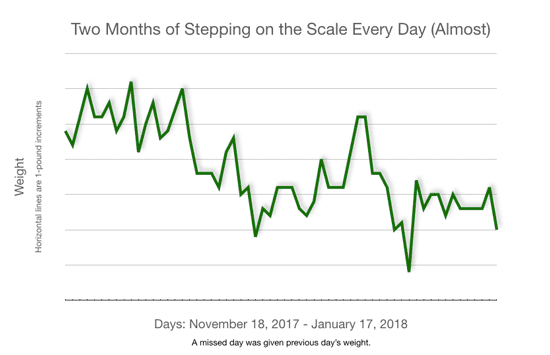
So, after years of writing about the benefits of regular weighing, it was time to put down my keyboard and hop on the scale.  On November 18, the week leading into Thanksgiving, I weighed myself for the first time in probably nine months and began my (almost) daily weighing program (see figure).

What did I discover over my first two months of weighing? Here are some highlights:
Routine. Creating a routine makes things easier. Decide when and where you’re going to weigh yourself and really try to stick to it. I chose first thing in the morning – bleary-eyed and before coffee. If you miss some days, don't stress. While I stepped on the scale on most days, I missed 11 weigh-ins over two months. Some days I was feeling too busy to do it.  Some days I just didn't feel like. But overall, I tried to keep missed days as outliers and used them as a time to remind myself that this was a goal I wanted to work on.   When it comes to routine and consistency, find what works best for you. Different approaches work for different people.
Fluctuations. Day-to-day there will be fluctuations in weight. Sometimes up. Sometimes down. That’s natural. Two days after my first weigh-in, my weight was up about two pounds and stayed there on-and-off for the next 10 days. And about 30 days after that, I had a seven-day stretch where my weight changed by over four pounds. And I had no real explanation for either of them. As you get used to these natural ups and downs, you learn to place less importance on them and see them as part of your larger trend. 
Mindfulness. One of the most important parts of daily weighing, I found, was simply the act of stepping on the scale. No matter what number came up, it helped me keep my goal in mind. This doesn’t mean you should obsess about weight. But daily weighing can help you be a bit more mindful about your weight goals throughout the day. The world that surrounds us is filled with cues that entice us to eat – a lot. Daily weighing can be one way that helps counter that influence, helping us be more mindful of our goals and keep an eye on making healthy choices. 
Frustrations. Daily weighing can have some frustrations, especially when the numbers don’t seem to reflect the work we’ve been putting in. In those times, it’s important to stay positive.  By weighing yourself you're gathering information that can help you adjust your approach and successfully work toward your long-term health goals. 
Big picture. While weight is important, it’s not the only important aspect of health. Weighing yourself every day shouldn’t become an obsessive exercise in working toward unrealistic or unhealthy weight goals. Rather, it should be a tool that helps us work toward sensible and healthy weight goals that we can maintain over time. A healthy weight should be one part of an overall healthy lifestyle that includes a good diet, regular exercise, not smoking, and other healthy behaviors.

Tuesday, January 2, 2018

Protect Your Children with the HPV Vaccine

by Dr. Lindsay Kuroki

Parents grow up wanting their kids to be healthy and happy. And taking control of your child’s health may be easier than you think with evolving research. We know that with healthy eating, encouraging exercise, staying safe in the sun, and getting scheduled vaccinations your child is on the right path to having a lower cancer risk later in life.

What’s even better news is that within the past decade, a specific vaccine has also been created to protect against at least five different types of cancers. This vaccine, the Human Papillomavirus (HPV) vaccine, is now recommended for all girls and boys during their annual check-ups. 

HPV is a common sexually transmitted infection with over 100 different types of strands in existence. In fact, HPV is so common that an estimated nine out of 10 sexually active people will at some point be infected with HPV. Often times, HPV does not present with symptoms, which makes it hard to know when someone may be infected. For this reason, it is important to protect your child against HPV, as some forms of HPV can cause multiple cancers. At least two strands of the HPV virus have been shown to cause cervical, vagina, and vulva cancers in women, penile cancer in men, and head and neck cancer in both men and women. HPV can live for a long time in a person’s body, so someone may not know they have HPV, or an associated cancer, until years after being intimate with someone who carried the HPV virus. Sadly, HPV contributes to over 31,000 new cases of cancer each year, but we can reduce that number by protecting our children with the HPV vaccine.

Unfortunately, nationwide only 65 percent of girls initiate the HPV vaccination series and 49 percent receive the two recommended doses, while only 56 percent of boys initiate and 37 percent complete the series.

The good news is now the HPV vaccine is available for boys and girls to protect thems before they become sexually active. It’s also safe and over 90 percent effective. This success rate could prevent over 90 percent of HPV cases, or eliminate 29,000 new cancer diagnoses each year.

The Centers for Disease Control and Prevention (CDC) recommends that both girls and boys be vaccinated with a two-shot vaccine around ages 11 – 12. The second vaccine will be administered within one year after the first dose. The vaccine can be given until age 26, and being vaccinated after exposure to HPV will help reduce their risk of contracting future HPV infections. Adolescents and young adults, starting at age 15, who receive the HPV vaccine will require a three-dose vaccination series.

Protect your family against cancer, as it’s never too early to reduce your child’s risk. Talk with your pediatrician to schedule your child’s HPV vaccination.


Tuesday, October 31, 2017

Room for Improvement: Rates of Cancer Risk Factors in Young Adults

As we've written about before on Cancer News in Context, good evidence points to the important role that behaviors in youth and young adulthood can have on cancer risk later in life.

Health habits started in youth not only have a longer time to impact risk, but they can also have unique and important interactions with the biology of certain developmental stages.  Smoking, for example, seems to have the biggest impact on breast cancer risk when it takes place in the years between a woman's first period and when she first gives birth.  Likewise, sun exposure and indoor tanning has its biggest impact on melanoma risk when it takes place early in life.

Though there is still a lot we don't know about the relationship between early life risk factors and disease risk later in adulthood - largely because the vast majority of studies to date have been done in middle-aged or older populations - it is clear from the studies we do have that the earlier in life we can cement healthy habits, the better.

Yet, a new study of national data shows that there's still great room for improvement in those critical early years. The study, conducted by researchers from the National Center for Chronic Disease Prevention and Health Promotion of the CDC, analyzed results from the 2015 National Health Interview Survey, which asked a random sampling of Americans about a range of health habits and related information.

Across nearly all behaviors reported, there were very few bright spots (see figure below).

Nearly 20 percent of all young adult men and women were obese, meaning they had a body mass index (BMI) of 30 or higher. For someone who is 5 feet, 5 inches tall, that translates to a weight of 180 pounds or more. And these numbers do not even include the percentage of young adults who were overweight (BMI 25 - 29.9) but not obese.  While obesity has the largest weight-related impact on the risk of cancer, simply being overweight also adds to risk.

While smoking rates have dropped dramatically from their high-points, 11 percent of young women and 15 percent of young men still smoke tobacco cigarettes.  And nearly 8 percent of young men use e-cigarettes, despite their short and long-term risks remaining largely unknown.

Though physical activity is one of the best ways to lower disease risk and improve health and overall quality of life, nearly 30 percent of young women and just over 20 percent of young men get little or no physical activity.

Indoor tanning - which can double the risk of deadly melanoma - remains relatively popular in young women.  While, overall, 11 percent of women ages 18 - 24 had used a tanning bed in the past year,  this number kicks up to 17 percent in non-Hispanic whites.  Two percent or less of young men had indoor tanned.

Perhaps the most striking numbers were the very high rates of sugary drink consumption, processed meat consumption, and lack of HPV vaccination.  Over half of men and women drank sugary drinks daily, which increases the risk of weight gain, among other health risk factors.  And over two-thirds of men and over half of women regularly ate processed meat, which increases the risk of colon cancer.

Approximately 58 percent of women 18 - 26 years old and 79 percent of men 18 - 21 years old had not had the HPV vaccine, despite it lowering the risk of multiple cancers - including those of the cervix, anus, penis, and throat (which is becoming increasingly common). (Data not included in figure).

We know that half of all cancers could be prevented with a healthy lifestyle, and that that number is likely higher when healthy behaviors start early in life and are maintained through adulthood.  The results of this new study show that much more work needs to be done to help instill healthy behaviors in childhood that then continue into the teens and early twenties and beyond.

Parents and other family members play a key role in helping children develop healthy habits.  As kids age, and their independence grows, they play an increasing role in their own health.  At all stages, though, neither parents nor kids nor adults exist in a vacuum.  Our health behaviors are influenced by numerous different factors.  Personal choice is just one.  And outside of that, our schools, neighborhoods, workplaces, friends and broader social circles, and local and state governments and policies have an important impact on the health behaviors we make and sustain.

Healthy school meals and daily PE can help lay the foundation for a lifetime of healthful eating and regular activity.  Nice sidewalks and bike paths can make it easier for families to get out for walks and bike rides.  Employers that provide affordable health insurance and allow time off for doctor's appointment make it easier for workers to get important preventive care and screening. Promotion of healthy choices by popular opinion leaders on Snapchat and Instagram can impact attitudes and choices of teenagers influenced by such social media. And targeted taxes on tobacco and sugary drinks can curb purchasing by youth and young adults, who are particularly sensitive to cost.

To make important headway against cancer and other preventable chronic diseases, we need to promote and support prevention on these multiple levels.  The lessons from tobacco show that such broad-based approaches work.  What is lacking in these other areas are appropriate resources and political will to tackle them as we've been able to do tobacco.

The return on the time and resources invested would, no doubt, be many times over.


Thursday, July 13, 2017

How Does Your State's Health Stack Up?

Ever wonder how you're state stacks up compared to others when it comes to important health risk factors? If so, a tool from the Centers for Disease Control and Prevention (below) can help you do just that. And while it can be fun to click through and explore the data from different states and for different risk factors, the tool helps illustrate an important point: that health, and the health choices we all make, are part of the broader world in which we live. The policies, infrastructure, and social environment that surround us can have an important influence on things like how active we are, what food we eat, and the preventive healthcare we get. For healthy individuals, and a healthy nation, these aspects need to work together: the healthy choices people make, and the settings that foster and support those choices.

Monday, July 10, 2017

Boston Nutrition Obesity Research Center: 25 Years of Progress on the Links Between Overweight and Cancer

At today's annual symposium of the Boston Nutrition Obesity Research Center (BNORC), CNiC's Dr. Graham Colditz delivered a plenary session talk reviewing BNOCR's 25-year contribution to the science on obesity and cancer.

A past associate director of the Center, Colditz also paid tribute to groundbreaking nutrition researcher, George Blackburn, who passed away in February 2017 and played a key leadership role in establishing BNORC and fostering its important work. In addition to discussing Blackburn's role in advancing such fields as obesity economics, chronic disease prevention, and bariatric surgery, Colditz also recounted how Blackburn's driven nature also translated to his driving habits on Boston's infamous roads, with oftentimes exciting results.
"George offered to drive me back to my office on Longwood Avenue," said Colditz. "I accepted, and am pleased to say I survived a dash through city traffic with George at the wheel, a harrowing experience I expect many other here have shared over the years." 

Despite the stress his driving may have caused in others, Blackburn, and BNORC in general, did a great deal to help shape our current understanding of health and prevention.  Key studies showed the important role of adult weight gain on the risk of heart disease and breast cancer - and that BMIs within the upper end of the "normal" weight range could still significantly increase the risk of diabetes and heart disease.

Findings like these played an important role in shaping national health policy, possibly most notably with the practical recommendation in the 1995 Dietary Guidelines for Americans that adults should "maintain or improve weight," rather than simply focus on trying to achieve a healthy weight, which is not practical for many people. Simply avoiding future gain could have large benefits across many types of diseases and across the nation.

Other advances the work of BNORC played a role in was in identifying links between overweight and cancer, with much of this work foundational to a 2016 International Agency for Research on Cancer (IARC) report detailing the strong association between excess weight and 13 different cancers, including: breast, colon and rectum, endometrial, esophageal (adenocarcinoma), gallbladder, gastric, kidney (renal cell), liver, multiple myeloma, ovary, pancreas, and thyroid.

As our understanding of the weight-cancer link grows, said Colditz, we may in the future be better able to personalize lifestyle recommendations for people - to help them lower their future risk of cancer or improve their prognosis as cancer survivors. As well, we may better be able to understand how to allocate resources across the population for maximum impact.

# # #

"BNORC: Contribution over 25 years to evidence on obesity and cancer."- Graham A. Colditz, MD, DrPH. Boston Nutrition Obesity Research Center Annual Symposium and Tribute to George Blackburn, MD PhD, Boston, MA (July 10, 2017).

http://www.cancermedia.org/slides/BNORC071017.pdf

Thursday, March 23, 2017

Another Look at Luck and Cancer: Risk Accumulation & Prevention

by Graham Colditz

The debate regarding luck, prevention, and cancer risk is in the media again today (see Science, NPR, Forbes, and many others).

The authors of this new paper -- a follow-up of their original published two years ago and which caused such stir -- make a clear effort too classify cancer risk as due to H - hereditary (our parents - who we cannot change), E - environmental exposures (modifiable risk factors, such as cigarette smoking, weight gain in adult years, and lack of physical activity) and R - rate of DNA damage accumulated as cells divide.  By taking this approach, however, we continue to focus on the underlying rate of division and DNA damage, not the factors that modify this rate and certainly are known to modify cancer risk.

Doll and Armitage showed in 1954 that 5 to 6 mutations were needed to generate cancer in lung, colon, and numerous other organ sites. Yes, the multistage model proposed in 1954 was largely correct based only on assessment of age and cancer mortality in the UK. Of course, back then, treatment did not change outcomes to any great extent.

Today, we have more evidence that the rate of DNA damage varies by age.  For example, breast cancer shows this clearly in animal models and through incidence in women. The stages of a woman's life are associated with different rates of cell division - faster from the time a woman has her first menstrual period to the time she has her first baby, then more slowly after each baby, to even slower after menopause (unless a women uses hormone therapy that consists of estrogen-plus-progestins).

We wrote on this some time ago, (see below) as have many others.


While risk accumulates through cell divisions, we know that avoiding smoking and other major risk factors dramatically reduces the risk of specific cancers.


As the cancer burden continues to increase globally, using what we know from decades of cancer research lets us as a society reap benefits now.  Our return on investment on what we already know is waiting to be collected.  We just need the foresight and political will to do it.

Friday, February 24, 2017

Doubling Down on Prevention: Heart Disease & Cancer's Shared Risk Factors


Even in parts of the country experiencing an early thaw, winter starts to feel a bit long by the end of February.  The days are still short. The temps are still low. And the trees are still mostly bare. 

Yet, even amidst all that, we can still take heart.  Not just because we're about to crest into March, and the first days of spring, but because February is literally "Heart" month.  American Heart Month - A federally designated month focused on raising awareness of the importance of heart disease and the steps that can help prevent and manage it. 

On top of this, February also happens to be Cancer Prevention Month, which is amazingly apt.  Heart disease and cancer are the first and second leading causes of death in the United States (see figure), together accounting for approximately 1.2 million deaths each year.  This takes an incredible toll on individuals and their families, as well as on the nation's health as a whole.  

Yet, at the same time, there's a positive message in the middle of the depressing numbers. Both heart disease and cancer are very preventable, which offers wonderful opportunities to make gains against the diseases. Approximately three quarters of heart disease and half of cancers could be avoided with overall healthy lifestyles. And most of the steps that lower the risk of one, also lower the risk of the other.

Shared health behaviors that can lower the risk of both heart disease and cancer, include:
  • Avoiding tobacco (and secondhand smoke)
  • Maintaining a healthy weight
  • Being physically active
  • Eating a healthy diet - rich in fruits, vegetables, and whole grains; and low in unhealthy fats and red/processed meat
  • Getting screening tests, for certain cancers and heart disease risk factors - Talk with a doctor about which apply to you
  • Considering taking a daily low-dose aspirin, if age 50 - 69 - But talk with a doctor first 

Health recommendations often fall into silos of information.  Breast cancer in this silo.  Heart disease in that one.  And colon cancer over there. This can make it easy to miss how important some basic healthy behaviors can be for preventing many key chronic diseases.  Yet it's hard to overstate the potential impact of a handful of healthy behaviors.

So, while we're getting ready to shed some layers and get outside more often as the calendar moves toward spring, why not use these last, focused days of winter to think about one or two things you can do to give a boost to your health and lower your risk of heart disease and cancer? 
  • Add one more piece of fruit to your lunch a few days a week.  
  • Buy that cereal that has whole gains as a first ingredient. 
  • Search for some new meatless recipes to try.  
  • Visit smokefree.gov for information about quitting smoking.  
  • Tell yourself you're going to do something physically active every day -- no matter how small.  
  • Call your clinic or doctor's office to see if you're up-to-date on recommended health screenings and make an appoint to get caught up if you're not. 

Doing these things is probably easier than you think, and the benefits of doing them probably greater. You've got this.

For more tips on making healthy changes, see 8IGHT WAYS to Stay Healthy and Prevent Cancer.  For personalized prevention plans and estimate of your risk of cancer, heart disease, and other conditions, see Your Disease Risk.

Monday, February 13, 2017

Cancer Missed Factors: Many People Unaware of Key Behaviors That Can Lower Cancer Risk

A new report from the American Institute for Cancer Research (AICR) shows that a large percentage of the United States population remains confused about which lifestyle factors increase the risk of cancer and which do not.

While a large majority of the public knows that smoking and sun exposure increase cancer risk, only 50 percent or fewer know that key risk factors like overweight, physical inactivity, alcohol, and processed meat increase risk.  In addition, many lifestyle factors with unproven or tenuous links to cancer were identified by high percentages as proven cancer risk factors. Between 52 - 60 percent of people incorrectly stated that genetically modified foods (GMOs), artificial sweeteners, hormones in beef, and food additives impact a person's chances of developing cancer. Good evidence does not support these links.

Based on a phone survey of a nationally representative sample of around 1,000 people, the AICR report is the eighth in a series, with the first published in 2001.

Perhaps the most surprising finding in the report is the continued low-level understanding that overweight and obesity increase cancer risk.  While there has been overall improvement since 2001, when just 35 percent of respondents identified the link between weight and cancer, the percentage has bounced around the 50 percent mark since 2009, seemingly stalled. Overweight causes over 130,000 cancers a year and increases the risk of over ten different cancers.

Studies show that half of all cancers could be prevented through healthy behaviors. And the list of key steps that lower cancer risk is generally straightforward and relatively short.  We highlight them in our Eight Ways to Prevent Cancer series (see figure), and AICR, the National Cancer Institute, and other such organizations have similar publications.

As the new report suggests, to help people realize these benefits, we need to continue to get the word out on these important prevention messages.  But our efforts must reach beyond the public and also include institutions throughout society - state/local governments, schools, healthcare systems, insurers, and workplaces.  For knowledge to transform into sustained action, reinforcement is key.  Our friends, our workplaces, our healthcare providers, and our community each play a key role in helping us meet our health goals.

From knowledge, to action, to impact.  Together, we can make this happen.


Monday, January 9, 2017

The Importance of Taking an Honest Look at Your Child's Weight

It's not news that parents can sometimes have blinders on when it comes to their kids. It's only natural that we look for all the positives in our children and downplay any possible negatives.

And this is just what seems to be happening with parents and the loaded issue of their child's weight.  Parents of overweight kids can have real trouble understanding that their child is actually overweight.  One 2013 review of studies found that over 60 percent of parents of overweight kids didn't know that their child was overweight.  And for young kids (ages 2 - 6 years), this number rose to over 85 percent.

While a child's weight has no bearing on his or her character or worth, it can have important lifelong implications for health.  Overweight children are at much greater risk of becoming overweight adults, which can then put them at increased risk for a host of weight-related issues ranging from diabetes and cancer to stigmatization and lower lifetime earnings.

With 17 percent of US youth ages 2 - 19 obese and nearly 6 percent extremely obese, it's important that parents, health professionals, and health systems try to be honest about childhood weight so that children have the chance to build healthy behaviors that will benefit them throughout life.

For parents, a good place to start is the CDC’s BMI Calculator for Child and Teen.  This tool uses a special calculation of weight, height, gender, and age to estimate whether a child is underweight, normal weight, overweight, or obese.  Because children are still growing and developing, these labels are not always perfectly accurate, so it’s important to bring up any concerns about your child’s weight directly with a healthcare provider.

Additional tips:
  • Keep track of your child’s weight, but don't obsess about it, and bring up any concerns with a health care provider.
  • Help your children focus on healthy food choices and healthy activities rather than on weight and body image.
  • Give your children the chance to be physically active every day.
  • Limit sweets and processed foods, which are often high in calories as well as carbohydrates that can stimulate hunger.
  • Limit TV, tablet, computer, and other screen time to under two hours a day. The less, the better.
  • Help your children get enough sleep by setting a bed time and sticking to it every day. Keeping electronics out of the bedroom also helps.
It's a simple step really -- taking an honest look at our child's weight.  But it can be a key step for helping a child move toward lifelong good health.

Photo: Family Walk by Thomas Leth-Olsen  (CC License, CC BY 2.0)