Showing posts with label diet. Show all posts

Thursday, February 21, 2019

Study Links Eating Whole Grains with Lower Risk of Liver Cancer

A large new study has found that regularly eating whole grains may significantly lower the risk of liver cancer. The study, published online in JAMA Oncology, followed 125,000 men and women for an average of 24 years, gathering information on participants' diet at regular intervals over that time.

The researchers found that those who ate the greatest amount of whole grains had a 37 percent lower risk of a common type of liver cancer (hepatocellular carcinoma) compared to those who ate the least. And benefits accrued with a relatively modest intake of whole grains, only around 33 grams a day. That's just over the amount in two slices of 100 percent whole-wheat bread, which has about 16 grams of whole grains per slice.

Despite being a large, well-designed study, the researchers were appropriately cautious in their conclusions and highlighted their study's limitations. There were relatively few cases of liver cancer among the participants, which makes it harder to rule out chance findings. Hepatitis infection, which is an important risk factor for liver cancer, was not well documented in participants, and so could not be fully taken into account in analyses, possibly impacting the accuracy of results.  And finally, the link between whole grains and liver cancer has only been looked at in a very small number of studies, so there is not yet enough evidence to draw solid conclusions about the links between the two.

Taking all that into account, the paper ends:
If our findings are confirmed, increasing whole grain consumption may serve as a possible strategy for prevention of primary HCC [liver cancer]. 

And if confirmed, these results would also further build on the already great evidence on the overall health benefits of a diet rich in whole grains, which we've written about previously in CNiC. From Be Less Refined: Eat More Whole Grains:

Whole grains are packed with fiber and other key nutrients and have been found to lower the risk of diabetes, heart disease, and certain cancers. They can also help keep weight in check and the digestive system running like clockwork.

For overall health benefits, the goal should be to eat three or more servings of whole-grains a day. One serving of whole grains is: 
  • 1 slice of 100 percent whole-wheat bread 
  • 1 cup of dry whole-grain cereal 
  • 1/2 cup of cooked brown rice, wild rice, or hot whole-grain cereal, like oatmeal 
While whole grains taste great, they can also take a bit of getting used to if you're used to eating mostly refined-grain foods, like white bread and white rice. So, take a little time to transition. Add one slice of 100 percent whole-wheat bread to your sandwich to start. Or mix equal parts, brown rice and white rice, or regular pasta with whole-grain pasta. Then, slowly make whole grains a bigger part of the total grains in your diet. 

The benefits are well worth the effort. 


Thursday, February 15, 2018

New Diet Study Finds "Ultra-Processed" Foods May Be Linked to Cancer Risk


by Hank Dart

A new study out of France highlights another possible reason to avoid eating too many highly processed foods:  They may increase the risk of cancer.

The paper, published yesterday in the British Medical Journal, followed close to 105,000 adults for an average of 5 years.  Along the way, participants were asked to regularly report their dietary intake and any health events, such as a diagnosis of cancer.

Foods were then categorized into groups, with an "ultra-processed" group including foods like: soda (diet or sugary); mass-produced sweets; meats with preservatives other than salt; instant noodles and soups; and foods with industrial food additives and agents.

The proportion of participants' diets that was made up of ultra-processed foods was determined by the weight of food, rather than by calories.  This was done to take into account the potential impact of processed foods that have few, if any, calories, like diet sodas.

The researchers found that for every 10 percent increase in the proportion of ultra-processed foods in the diet, the overall risk of cancer increased by 12 percent and the risk of post-menopausal breast cancer increased by 13 percent.  

Risks were more pronounced when comparing high intake of processed foods with low intake. Participants who ate the most ultra-processed foods had a 21 percent higher risk of cancer overall and a 39 percent higher risk of post-menopausal breast cancer.  They also may have had a higher risk of colorectal cancer, but those results were less reliable.

In the analyses, researchers took into account many factors that could have swayed the results because they could be related to both processed food intake and cancer.  These included factors such as physical activity level, body mass index, alcohol intake, tobacco use, and overall diet quality.

In an accompanying editorial, Adriana Monge of the National Institute of Public Health in Mexico City and Martin Lajous of the T.H. Chan School of Public Health at Harvard University praised the researchers for their detailed study but recommended caution in interpreting such initial results.
"...as with any observational study, confounding by unknown factors common to consumption of ultra-processed foods and cancer outcomes cannot be excluded." 
"Their interesting results require replication and further refinement."
"We are a long way from understanding the full implications of food processing for health and wellbeing."

While more study is needed on the possible links between ultra-processed foods and cancer, well-established dietary recommendations call for limiting certain types of processed foods, which can be high in calories, sodium, refined grains, added sugar, and unhealthy fats -- and low in healthy nutrients.

A largely plant-based diet that is low in unhealthy processed foods and filled with fruits, vegetables, beans, and whole grains is best for overall health and can lower the risk of many important chronic diseases, including cancer.

Wednesday, January 24, 2018

In Practice: What I Learned from Weighing Myself (Almost) Every Day

by Hank Dart

In my many years of writing about and promoting healthy behaviors, I’m happy to say that I’ve at least tried to put into practice just about everything I’ve espoused. Of course, like many people, my success at doing so can be uneven. Some behaviors I do pretty well with - like exercise, olive oil, and fruits & vegetables. And some I admittedly struggle with - like, whole grains and added sugar.

But there’s one behavior I've written about a great deal but have never actually done myself. Regular weighing.  Stepping on the bathroom scale every day (or every week) and logging my weight.

Studies show that regular weighing can be a good tool for maintaining weight, especially in those who have lost weight and are working to keep it off. Because weight gain can creep up on people - a pound here, two pounds there - it's pretty easy to step on the scale after some months or years away and be surprised at the number staring up at you. Regular weighing can keep such jolts at bay and help us make small adjustments to how much we eat and how active we are so we can keep moving toward our long-term weight goals – whether it’s keeping weight steady or trying to slowly lose some weight.

And weight is a struggle for most of us in the United States.  Over two-thirds of the population is overweight or obese, and this has a huge impact on the health of individuals and the nation.  Being overweight is a cause of numerous cancers as well as heart disease, stroke, and diabetes.  It can also hamper mobility and overall quality of life.

So, after years of writing about the benefits of regular weighing, it was time to put down my keyboard and hop on the scale.  On November 18, the week leading into Thanksgiving, I weighed myself for the first time in probably nine months and began my (almost) daily weighing program (see figure).

What did I discover over my first two months of weighing? Here are some highlights:
Routine. Creating a routine makes things easier. Decide when and where you’re going to weigh yourself and really try to stick to it. I chose first thing in the morning – bleary-eyed and before coffee. If you miss some days, don't stress. While I stepped on the scale on most days, I missed 11 weigh-ins over two months. Some days I was feeling too busy to do it.  Some days I just didn't feel like. But overall, I tried to keep missed days as outliers and used them as a time to remind myself that this was a goal I wanted to work on.   When it comes to routine and consistency, find what works best for you. Different approaches work for different people.
Fluctuations. Day-to-day there will be fluctuations in weight. Sometimes up. Sometimes down. That’s natural. Two days after my first weigh-in, my weight was up about two pounds and stayed there on-and-off for the next 10 days. And about 30 days after that, I had a seven-day stretch where my weight changed by over four pounds. And I had no real explanation for either of them. As you get used to these natural ups and downs, you learn to place less importance on them and see them as part of your larger trend. 
Mindfulness. One of the most important parts of daily weighing, I found, was simply the act of stepping on the scale. No matter what number came up, it helped me keep my goal in mind. This doesn’t mean you should obsess about weight. But daily weighing can help you be a bit more mindful about your weight goals throughout the day. The world that surrounds us is filled with cues that entice us to eat – a lot. Daily weighing can be one way that helps counter that influence, helping us be more mindful of our goals and keep an eye on making healthy choices. 
Frustrations. Daily weighing can have some frustrations, especially when the numbers don’t seem to reflect the work we’ve been putting in. In those times, it’s important to stay positive.  By weighing yourself you're gathering information that can help you adjust your approach and successfully work toward your long-term health goals. 
Big picture. While weight is important, it’s not the only important aspect of health. Weighing yourself every day shouldn’t become an obsessive exercise in working toward unrealistic or unhealthy weight goals. Rather, it should be a tool that helps us work toward sensible and healthy weight goals that we can maintain over time. A healthy weight should be one part of an overall healthy lifestyle that includes a good diet, regular exercise, not smoking, and other healthy behaviors.

Monday, July 10, 2017

Boston Nutrition Obesity Research Center: 25 Years of Progress on the Links Between Overweight and Cancer

At today's annual symposium of the Boston Nutrition Obesity Research Center (BNORC), CNiC's Dr. Graham Colditz delivered a plenary session talk reviewing BNOCR's 25-year contribution to the science on obesity and cancer.

A past associate director of the Center, Colditz also paid tribute to groundbreaking nutrition researcher, George Blackburn, who passed away in February 2017 and played a key leadership role in establishing BNORC and fostering its important work. In addition to discussing Blackburn's role in advancing such fields as obesity economics, chronic disease prevention, and bariatric surgery, Colditz also recounted how Blackburn's driven nature also translated to his driving habits on Boston's infamous roads, with oftentimes exciting results.
"George offered to drive me back to my office on Longwood Avenue," said Colditz. "I accepted, and am pleased to say I survived a dash through city traffic with George at the wheel, a harrowing experience I expect many other here have shared over the years." 

Despite the stress his driving may have caused in others, Blackburn, and BNORC in general, did a great deal to help shape our current understanding of health and prevention.  Key studies showed the important role of adult weight gain on the risk of heart disease and breast cancer - and that BMIs within the upper end of the "normal" weight range could still significantly increase the risk of diabetes and heart disease.

Findings like these played an important role in shaping national health policy, possibly most notably with the practical recommendation in the 1995 Dietary Guidelines for Americans that adults should "maintain or improve weight," rather than simply focus on trying to achieve a healthy weight, which is not practical for many people. Simply avoiding future gain could have large benefits across many types of diseases and across the nation.

Other advances the work of BNORC played a role in was in identifying links between overweight and cancer, with much of this work foundational to a 2016 International Agency for Research on Cancer (IARC) report detailing the strong association between excess weight and 13 different cancers, including: breast, colon and rectum, endometrial, esophageal (adenocarcinoma), gallbladder, gastric, kidney (renal cell), liver, multiple myeloma, ovary, pancreas, and thyroid.

As our understanding of the weight-cancer link grows, said Colditz, we may in the future be better able to personalize lifestyle recommendations for people - to help them lower their future risk of cancer or improve their prognosis as cancer survivors. As well, we may better be able to understand how to allocate resources across the population for maximum impact.

# # #

"BNORC: Contribution over 25 years to evidence on obesity and cancer."- Graham A. Colditz, MD, DrPH. Boston Nutrition Obesity Research Center Annual Symposium and Tribute to George Blackburn, MD PhD, Boston, MA (July 10, 2017).

http://www.cancermedia.org/slides/BNORC071017.pdf

Thursday, March 23, 2017

12 Little Things That Can Put a Hitch in Your Efforts to Keep Weight in Check - And Ways to Fix Them


by Hank Dart

Even in the middle of the roiling media cycle we're in, diet has still managed to break through and make headlines the past couple weeks. Probably the biggest recent story was the release of a paper in the Journal of the American Medical Association that found that around 40 - 50 percent of deaths in the United States from heart disease, stroke, and diabetes could be linked to unhealthy eating. Big culprits were eating too much sodium and processed meat, and not enough nuts, seeds, and fish rich in healthy fats.

Following on the heels of this was a paper in the journal Cancer Causes and Control by Isabelle Romieu of the International Agency for Research on Cancer (IARC), which detailed the key drivers of energy imbalance that lead to obesity. Energy imbalance, when it comes to weight gain, simply means consuming more calories than you need, which over time can lead to becoming overweight and possibly obese.

And, as many of us have frustratingly found, it doesn't take too many of these extra calories to put on weight, something Romieu and her co-authors highlight -
"Very small deviations from energy balance, on the order of 1 - 2% of daily energy intake, can result in large long-term change in body weight (~20kg)[Ed: ~44lbs]."
For a moderately active adult woman, for example, 1 - 2 percent is only about 20 - 40 extra calories a day. That's the splash of cream in a morning coffee, three ounces of sugary soda, or half a small cookie. Or looking at it from the other end, that's the calories burned by walking less than half a mile. Not much at all.

Clearly, the little things we do in relation to how we eat and how active we are can really matter, especially over time. So, let's take a look at some of the little things that can put a hitch in our best efforts to keep in energy balance.

 Most likely, we all have at least one or two -- and probably more -- that we do regularly. The good news: because they're little, or at least little-ish, they're sometimes not too hard to start to tackle. 

Why not begin today?

Eating too fast
It's a go, go, go world these days, and that mindset can transfer to our eating, too. But eating food fast can easily lead to overeating because our minds and stomachs need some time to synch up. You can quickly down two hot dogs, a shake, and large fries before your mind has had a chance to register the first hot dog and tell you you've had enough. Before you know it, you feel stuffed and may have eaten a 1,000 calories more than your body actually wanted.

The fix: Simply try to slow down at each meal. Take time between bites. Enjoy your food. This slower pace can put your stomach and mind in better synch and help you feel satisfied with less food.


Ordering "the works"
Steer clear of ordering anything with "the works." Along with "stuffed crust" and "extra whip," "the works" are two terrible words to utter when you're working to keep calories in check. Whether on a potato, hamburger, or dessert, "the works" is usually just a vehicle for extra calories you may not even enjoy all that much.

The fix: Try low-calorie toppings instead, like fresh fruit, tomatoes, or salsa.


Being swayed by advertising
Most food companies want to get us to eat and drink - and the more the better. And they spend billions of dollars a year on advertising to get us to do just that. So, it's important to try to develop a bit of media savvy when it comes to advertising, so we can make clear, objective choices about the food we eat.

The fix: When you see a food ad, just take a moment and ask yourself: Why is the company paying for this ad? Is the ad a true depiction of what buying and eating the food is like? Is the food a healthy choice for me and my family? Most of the time, the answers will speak for themselves.


Driving a lot
Many of us need to spend way too much time in cars -- or on buses or subways. It's just a fact of life. We have to get to and from work, pick up the kids, and run errands. But many times, we also take the car or other transportation when we could just as easily walk or ride a bike. And this cuts out a great opportunity to easily add some physical activity to our days.

The fix: If it's safe, try to do some errands on foot or by bike a couple times a week. Then, build from there.


Eating mindlessly
Most of us do some amount of automatic eating -- eating without really thinking about it because there's food in front of us, our favorite TV show is on, or it's a certain time of day. But such mindless eating, usually when we're not even hungry, can add a lot of extra calories to our days.

The fix: Just take a moment and think before you eat. Ask yourself: Am I actually hungry? If you're not, try to do something other than eating for while. Go for a quick walk, play a game, even do some chores or errands you've been putting off.


Throwing in the towel 
Set-backs are natural. We're human. But don't let set-backs frustrate you into abandoning your health goals - even for a day. Yes, you ate five pink cookies you hadn't plan to and missed your workout. That's OK. Keep the long view.

The fix: Stay positive and know that health is a journey. And journeys are rarely straight lines to a destination. There can be twists and turns. Just get back on track and keep moving forward -- knowing you can get where you want to be.


Drinking calories
A lot of beverages are packed with calories -- sugary soda, sweet tea, and many types of blended coffee drinks. On top of this, it's been shown that our bodies don't register these liquid calories as readily as those from food. So, we often don't compensate for beverage calories by eating fewer food calories. The result: extra calories in our day.

The fix: Choose water or unsweetened tea and coffee instead of sugary drinks. Start with just one or two days a week, but eventually try to get down to zero sugary drinks. It's probably not as hard as you think.


Being too refined
Being refined in life is wonderful, but eating too many refined grains is not. Refined grains -- which make up foods like white bread, white rice, and regular pasta -- have had most of their fiber and nutrients stripped out in processing. Diets rich in less-processed whole grains -- like, 100% whole wheat bread, brown rice, and old-fashioned oatmeal -- have been shown to help keep weight in check.

The fix: Try to start buying more whole-grain foods. There are a lot of options these days. Look for foods with "whole" or "whole-grain" as a first ingredient and not too much sugar (7grams/serving or less).


Avoiding the bathroom scale
Not many people enjoy stepping on the bathroom scale. But avoiding it for long periods can lead to unwelcome surprises. Weight gain has a way of sneaking up on people. An extra pound here and an extra pound there can really add up over time. Stepping on the scale weekly, even daily, can help us keep track of our weight and adjust how much we're eating and how active we are.

The fix: Set a date with your scale -- every Tuesday at 7am, say -- and keep it. Want to go a step further? Keep track of your weight with a paper log or smartphone app.


Ignoring calorie labels
One thing's clear by now: calories matter. And although it's not essential to painstakingly track how many calories are in the food we eat, it can be helpful to have a general idea. Some meals, especially when we're eating out, can have a surprisingly large number of calories, at times bordering on a whole day's worth.

The fix: Many restaurants and fast food places post calorie-counts on menus, so they're pretty easy to find. Given them a quick read before you order, so you know what you're getting, and adjust if you need to.


Eating out for lunch - a lot
Eating lunch out -- whether at a restaurant, fast-food place, or food truck -- is often fun, tasty, and easy. But there can be downsides, too. It can be unhealthy, expensive, and calorie-packed.

The fix: Try to brown-bag it more often. Packing your lunch with healthy foods, in modest portions, means you're more likely to keep calories in check.


Waiting 'til tomorrow
Trying to get on a healthier path -- whether it's walking more or eating more fruits and vegetables -- isn't always easy. So, it's natural to want to put things off. And a day here or a day there may not make much difference, but the more you put things off, the more likely you are to keep putting things off. The sooner you get started on a healthier path, the sooner it'll become second nature to you, and the sooner you'll start getting benefits.

The fix: Try a new healthy behavior today, no matter how small it may seem. It can be buying a banana at lunch or walking to a bus stop that's further away than usual. Then keep it up, building over time with other healthy changes. 

You've got this.

Monday, May 2, 2016

Be Less Refined: Eat More Whole Grains

Editor's note: This post originally appeared as a Health Beyond Barriers podcast on Minds Eye Radio. It was produced in English, Spanish, Bosnian, Vietnamese, and Arabic through a collaboration with LAMP, Language Access Metro Project.
By Hank Dart

Whole grains. For something so often recommended as part of a healthy diet, they can seem pretty elusive.

We sort of know what they are - but not really.

We know we should be eating more of them - but don't really know how best to do that.

Well, the good news is that whole grains are pretty easy to get a grasp on with just a handful of helpful tips.

But, first, let's try to answer the question:
Why should we even care about whole grains?
As with most diet recommendations, the quick answer to this question is: for your health.

Whole grains are packed with fiber and other key nutrients and have been found to lower the risk of diabetes, heart disease, and certain cancers. They can also help keep weight in check and the digestive system running like clockwork.

On top of this, research has found that whole grains can lower the risk of dying prematurely. Results from a study that followed over 74,000 women and 43,000 men for around 25 years showed that those who ate the most whole grains over that time had a nearly 10 percent lower risk of dying from any cause than those who ate the least.

So, whole grains aren't just an out-of-the-blue recommendation put together by disgruntled dieticians. They can have a real impact on many of the most important - and preventable - diseases.

With that in mind, let's move on to the next big question:
What are whole grains?
Most of us know what grains are. They are things like wheat, oats, rice, bulgur, and millet. This is an incomplete list, but you get the idea.

In their natural state, grain kernels have three key parts - bran, germ, and endosperm. When a grain contains all three of these it is considered a whole grain.

This is different from "refined" or "enriched" grains - like white rice and white flour - that have the bran and germ removed during processing. Bran and germ are rich in many healthy compounds, like fiber, vitamins, minerals, and phytoestrogens.

So, now that what we know what they are, we need to ask:
What amount of whole grains should we eat?
The latest Dietary Guidelines for Americans recommends that at least half of the grains we eat each day should be whole grains. While that's a little ambiguous - for most adults, it translates to about 3 - 4 ounces of whole grains every day. That's the equivalent of around 3 - 4 slices of whole grain bread, or 1½ to 2 cups of cooked brown rice. Every day.

It's not a huge amount, but it's enough that it's important to make sure you have enough healthy whole grain foods on hand. Which begs the question:
What's the best ways to find healthy whole grain foods at the store?
Luckily, we're all probably familiar with a number of healthy whole grains, like - 100% whole wheat bread, brown rice, bulgur, rolled oats, and even whole-grain pasta. So to buy more whole grains, all we need to do is take the extra step of actually putting them in our shopping carts more often.

After these easy-to-find foods, it can get a little trickier to identify healthy whole grain foods, but it's not really that hard.

First, and most important: Let the label be your guide.

Choose foods that have as the first ingredient on the food label a grain that starts with words like "whole grain" or "whole." The first ingredient in the list is the most common ingredient in the food. So, if the label on your breakfast cereal starts with "whole grain oats," then whole grain oats are the main ingredient.

This isn't a perfect system because some foods can have whole grains as a first ingredient but also have a lot of added sugar. Sugary breakfast cereals can be a good example of this. So it's best to choose whole grain foods that also have little or no added sugar.

It's also important not to let the color of a food be your only guide. Some dark breads, for example, may seem to have a lot of whole grains in them, but in fact, may have little in any - getting their color from things like molasses.

Now that we know how to find healthy whole grains, let's ask one final question:
What's the best way to fit more whole grains into our diet?
The one word answer: slowly.

If you've been eating a lot of refined grain foods, moving to whole grains can take some getting used to. Whole grains have an appealing and complex taste, but they do taste different than refined grains. So making the transition slowly gives you time to adjust and build up habits for long term success.

Start by mixing half-and-half white rice and brown rice. Do the same with white pasta and whole-grain pasta - and other grain foods you regularly eat.

Then slowly increase the amount of the whole grain foods. Over time, you may not even miss the refined grain options.

Making healthy whole grain choices doesn't mean giving up completely on the refined grain foods we like. With a little effort, though, we can add more whole grains into our day and give our diets, and our health, a real boost.

And don't we all deserve that?


Additional resources

The Nutrition Source - Harvard School of Public Health
http://www.hsph.harvard.edu/nutritionsource/whole-grains/

Choose My Plate - USDA
http://www.choosemyplate.gov/grains-tips

Dietary Guidelines for Americans 2015 - 2020
http://health.gov/dietaryguidelines/2015/guidelines/

Your Disease Risk - Siteman Cancer Center
http://www.yourdiseaserisk.wustl.edu


References

1. Dukas L, Willett WC, Giovannucci EL. Association between physical activity, fiber intake, and other lifestyle variables and constipation in a study of women. Am J Gastroenterol 2003;98:1790-6.

2. Ye EQ, Chacko SA, Chou EL, Kugizaki M, Liu S. Greater whole-grain intake is associated with lower risk of type 2 diabetes, cardiovascular disease, and weight gain. J Nutr 2012;142:1304-13.

3. Aune D, Chan DS, Lau R, et al. Dietary fibre, whole grains, and risk of colorectal cancer: systematic review and dose-response meta-analysis of prospective studies. BMJ 2011;343:d6617.

4. Huang T, Xu M, Lee A, Cho S, Qi L. Consumption of whole grains and cereal fiber and total and cause-specific mortality: prospective analysis of 367,442 individuals. BMC Med 2015;13:59.

5. Wu H, Flint AJ, Qi Q, et al. Association between dietary whole grain intake and risk of mortality: two large prospective studies in US men and women. JAMA internal medicine 2015;175:373-84.

6. US Departments of Agriculture and Health and Human Services. Scientific Report of the 2015 Dietary Guidelines Advisory Committee. Washington, DC: US Departments of Agriculture and Health and Human Services; 2015.


Tuesday, March 29, 2016

Potential of Prevention: Only 3 Percent of Us Meet 4 Key Health Behaviors


by Katy Henke

When it comes to leading a healthy lifestyle, let's just say that Americans have a lot of room for improvement. That's according to a recent study published in Mayo Clinic Proceedings that found that only 2.7 percent of U.S. adults practice four key behaviors that can improve health and lower the risk of important chronic diseases.

The study analyzed data from more than 4,700 people who volunteered for the U.S. National Health and Nutrition Survey. Researchers were specifically interested in learning how many Americans follow four key guidelines for living healthy: not smoking, eating a healthy diet, exercising a moderate amount, and keeping body fat in a healthy range.

Around 34 percent did one of these healthy behaviors. Around 37 percent did two. Just under 3 percent did all four. And 11 percent did none at all.

What these results show is that the great majority of Americans can make changes in their lifestyles that can have an important impact on their risk of the most common diseases in the US, including heart disease, stroke, type 2 diabetes, and cancer. At least half of these diseases can be prevented by things we can all do.

So what can we do to create a healthy lifestyle? It’s pretty straightforward.
  1. If you smoke, try quitting immediately. Quitting can be the best thing you do for your overall health. Contact 1-800-QUIT-NOW or smokefree.gov today for ways to quit and support along the way.
  2. Exercise regularly. It’s recommended that adults exercise at a moderate level for 150 minutes each week. Think of that as 30 minutes each day for 5 days a week. Walk with your family after dinner, play games with your children or dance at home. Any amount is better than none.
  3. Eat a healthy diet. Focus on fruits, vegetables, and whole grains. Remember to cut back on red meats and unhealthy saturated and trans fats. Consider a multivitamin with folate for a little boost to your diet.
  4. Maintain a healthy weight. Focus on exercising daily and eating a healthy diet. It's also important to watch portions, eat slowly, and be especially mindful of how much you eat. Calories really matter. 
In addition to these four strategies, check out Your Disease Risk, an online prevention tool that estimates your risk of important chronic diseases and offers personalized tips for lowering risk.

Change can be hard. And living a healthy lifestyle isn't always easy -- Just ask the 97 percent of folks who missed perfect marks in this latest study. But decades of research show that it’s worth the effort, greatly lowering the risk of many diseases and improving overall health.

Get started today, and you'll be well on your way to a healthier you.

Tuesday, February 2, 2016

New Study Finds High Fiber Diet Early in Life Lowers Breast Cancer Risk


by Hank Dart

Though coverage of the Iowa caucuses has eclipsed most other media stories this week, there was still some important health news Monday about a large study finding that a high-fiber diet early in life may lower the risk of later adult breast cancer.

The study, part of the long-running Nurses' Health Study II, included over 44,000 adult women who were followed for 20 years and provided details on what they ate both in their early adults years and during high school.  Fiber intake in both periods of life were found to have an important impact on breast cancer risk, particularly for cancer that develops before menopause.

Women who ate the most fiber as adolescents (around 29 grams/day) had a 24 percent lower risk of premenopausal breast cancer compared to women who ate the least fiber as adolescents (around 18 grams/day).  For fiber intake in the early adults years, the findings were nearly identical, with those eating the most (around 26 grams/day) having a 23 percent lower risk of premenopausal breast cancer than those eating the least (around 12 grams/day).  And for every 10 grams per day of fiber the women ate in early adulthood or adolescence, the risk of overall breast cancer (premenopausal and postmenopausal combined) dropped by 13 or 14 percent, respectively.

Three pieces of 100 percent whole wheat bread has around 10 grams of fiber.

As we've written about previously here in CNiC, and in our new ebook TOGETHER - Every Woman's Guide to Preventing Breast Cancer, more and more evidence points to youth and the young adults years as key to lifelong breast health. And these current findings build on previous results suggesting that plant-based diets high in fiber can reduce breast cancer risk.

For parents looking to help their daughters make food choices that can help lay a foundation for lifelong breast health, there are some simple steps.  Help them focus on fruits, vegetables, nuts, and whole grains, while limiting full-fat dairy and meat -- and avoiding alcohol (more). Also key is healthy growth, helping them develop lasting eating and activity habits that help them maintain a healthy weight throughout life (more).  

We know that half of all breast caners can be prevented by steps most women can take.  This new study further confirms that lifestyle choices can have an important impact on breast cancer risk and that a cancer prevention lifestyle can almost never begin too early.

Monday, December 28, 2015

2015's Top Posts on Cancer News in Context

It's been another big year of cancer prevention news, and it started with a real splash way back in January with a headline-grabbing study in Science attributing most cases of cancer to simple "bad luck." Not surprisingly, we disagreed with that conclusion, and our post responding to the study - and the stories it generated - was one of the most popular on Cancer News in Context in 2015. Other popular posts ran the gamut of topics: from links between sugary sodas and earlier periods; to risk-reducing diet tips; to the on-going problem of tanning bed use by youth and young adults. 
As we get set for another eventful year, here are our top 5 posts from 2015, in order of popularity:
-   -   -   -

February 3, 2015

Study Finds Periods Start Earlier in Girls Who Drink a Lot of Sugary Drinks. What Does This Mean for Breast Cancer Risk? 

A new study released last week in the journal Human Reproduction has found that regularly drinking sugar-sweetened beverages - like sodas and fruit drinks - may cause girls to start their menstrual periods at earlier ages.

The study, a spin off of the long-running Nurses' Health Study at Harvard University, followed around 5,000 9 - 14 year old girls for up to five years - tracking their food, beverage intake, and menstrual status along the way.  Researchers found a distinct link between regularly drinking sugary beverages and the age periods started (technically called, menarche).  Those girls who drank more than 1.5 servings of soda or fruit drink each day started their period on average at 12.8 years, about three months earlier than girls drinking 2 or fewer servings each week. Even after taking body mass index (BMI) into account, which is linked to age at menarche,  the same general association remained.

So, what does this have to do with cancer?

There's increasingly good data that early life plays a particularly important role in later adult breast cancer risk, something we've certainly written about here on CNiC.  This new study provides further evidence....

>>continue reading 

Photo: Creative Commons Lic. (cropped): Flickr/zingersbs


January 8, 2015

Setting the Record Straight on Cancer Prevention: Lifestyle Trumps "Bad Luck" 

It's been hard to avoid the headlines this past week touting the conclusions of a new study in the journal Science that cancer is a disease largely caused by "bad luck."  Some of these headlines have been sensationalized; some have been more measured.  Together, they've seemed nearly ubiquitous.  And in some ways that's been positive, demonstrating that cancer - and its causes and prevention - remain an important topic to both the public and the media.


Unfortunately, the conclusions of the paper - and the subsequent coverage they've received - seem to reach well beyond what the actually findings of the study support, and in doing so, have incorrectly called into question what decades of overwhelming evidence shows:  that over half of all cancers - and up to three quarters of some cancers - could be prevented by regular screening and healthy lifestyle choices.

The new study by Johns Hopkins researchers Cristian Tomasetti and Bert Vogelstein gathered data on the number of stem cell divisions that occur in various tissues in the body and compared these data to annual incidence rates of cancers in those tissues.  Stem cells divide to replace cells in tissue that die or are lost.  This maintains the tissue.  Some tissues need a lot of cell divisions for maintenance.  Others need less.  When cells divide, the DNA in cells also replicate and divide, opening up the chance for random mutations that could eventually lead to cancer.

The researchers found a strong correlation between tissues' number of stem cell divisions and cancer in those tissues, attributing 65% of cancers to these divisions, and the random DNA mutations that can occur with them.

While the study is well-designed and executed, it also has...

>>continue reading 


August 31, 2015

Bottom Line of New Study: Colon Cancer is Quite Preventable

A large proportion of colon cancer is preventable with healthy lifestyle choices, even without taking into account the benefits of screening.  That's the finding in a new analysis from the large Nurses' Health Study released in print last week in Cancer Causes & Control.  The analysis, done by researchers from Stanford and Harvard Universities, calculated the percentage of colon cancers in women that could be attributable to a combination of lifestyle choices that have been found in previous research to be established risk factors for the disease: overweight/obesity, lack of physical activity, alcohol intake, smoking, low multivitamin use, and low calcium intake.

Comparing women who had only one or none of these risk factors with women having two or more, the researchers found that 37 percent of colon cancer cases in women could be avoided through healthy lifestyle choices.  This proportion was even higher when aspirin use was considered.  Though not a lifestyle choice, per se, long term aspirin use has been shown in many well-designed studies to lower the risk of colon cancer.  When aspirin use of just twice a week for six years or more was added to the analysis, the percentage of cancers estimated as preventable rose to 43 percent.

These percentages are quite significant and do not even take into account the further benefit of colon cancer screening, which in addition to catching cancer early can also prevent the disease by finding (and removing) pre-cancerous growths.

Though some other analyses have estimated...

>>continue reading
Photo: Creative Commons Lic. Flickr/thomasletholsen


January 12, 2015

Preventing Skin Cancer: Tanning Beds Still Alluring, Still Very Risky


There was a nice piece in the New York Times this weekend on the risks of indoor tanning, particularly in youth. Focussing on the personal experiences of a handful of young women and their  parents, it does a very good job highlighting the well-established risks of skin cancer and deadly melanoma, the continued allure of tanning, and some promising advances in tanning salon regulation and rates of tanning by youth.

We've written a number of posts over the years here on Cancer New in Context (see below) about the dangers of tanning beds and the need for better policies to curb their use and protect youth. So, it's good to see the topic continuing to gain traction both in terms of awareness and in the willingness of state and federal government to take important tax and regulatory action to try to maintain the recent downward trend in tanning bed use.
In many ways, it's similar to the concerted efforts that have helped curb tobacco use over the past 50 years, a similarity not lost on 22 year-old Westfield State University student, Elizabeth LaBak, who was highlighted in the Times article:
“The tanning thing is like the smoking thing,” she said. “Everyone used to smoke. And then they said, ‘You’ll die of lung cancer.’ That’s what’s happening to tanning.”
As this quote sums up...

>>continue reading
Photo: Creative Commons Lic. Flickr/whatshername


September 17, 2015

Eating to Lower Cancer Risk: Replacing Superfoods with Science

by Graham Colditz, MD, DrPH

Article originally appeared in the Washington University - Institute for Public Health Blog

When it comes to cancer, there are few topics as supercharged as diet. A quick search of “diet and cancer” in Google News alone returns over 3 million stories. And yet, however large these numbers are, they don’t fully capture the passion that many people feel about the food/cancer link. There’s something special, elemental even, about making sure the food we eat is as safe and as healthy as possible – for us and for our loved ones.

Yet, however motivated people are to make healthy food choices, there are a lot of mixed signals out there on what to eat to lower cancer risk. Magazines and websites often tout “superfoods” and “cancer-busters” that rarely match up with official eating recommendations, and even these official recommendations seem to change month to month with the release of new – and often seemingly contradictory – study results.

Trying to decide what to eat can be an exercise in frustration, a sentiment captured perfectly in findings from a 2007 paper on public beliefs about cancer prevention. In this national sample survey, over 70 percent of respondents agreed with the statement that “there were so many recommendations about preventing cancer that it’s hard to know which ones to follow” (1).

The reality, though, is that when all the evidence on the links between diet and cancer are looked at together, clear and simple messages rise to the surface. These messages contain no “superfoods” or “cancer-busters” and, so, may not always lead the headlines. But what they may lack in headline-grabbing flash, they more than make up for by being recommendations based in solid science. And that’s really what matters.

Watch the calories
We see them listed everywhere and so have become inured to them in a way, but calories really matter when it comes to cancer risk. In fact, they’re probably the single most important aspect of diet when it comes to preventing cancer. Consistently eating too much can lead to weight problems. And, among other health risks, obesity is an established risk factor for at least eight different cancers and is responsible for 120,000 cases each year in the United States (2,3).

Over two-thirds of the nation is either overweight (BMI 25 – 29.9) or obese (BMI 30 or over), and studies consistently demonstrate that people have difficulty recognizing if they – or their children – are an unhealthy weight. Add to this the increasingly sedentary lifestyles that go along with modern society, and it takes a concerted effort by most people to moderate calories and keep weight in check over the course of their lives (4). These simple tips can help keep calories and weight in control:
  • Avoid sugary drinks, like sodas, energy drinks, and sports drinks. Even 100% juice should be kept to small amounts each day.
  • Focus on eating mostly plant-based foods, like whole grains, fruits, and vegetables. 
  • Be a more mindful eater. Start with smaller portions, eat slowly, and try to eat only when truly hungry. 
  • Fit physical activity into each day. More is almost always better, but any amount is better than none. 
  • Weigh your self on most days. It’s easy, keeps surprise weight gain at bay, and helps you make diet/activity adjustments in a timely manner.

Limit food from animals 
You don’t need to go full vegetarian – unless you want to – but there’s compelling data that eating fewer animal-based foods can lower the risk of colon cancer, prostate cancer, and possibly breast cancer (5-7). Try to eat fewer than three servings of red or processed meat each week, and choose more plant-based sources of protein and fat, like nuts, beans, and vegetables.  
Focus on fruits, vegetables, and whole grains 
The data linking fruits and vegetables as a whole with lower cancer risk...

>>continue reading
Photo: Creative Commons Lic. Flickr/Colin Brace

Thursday, December 17, 2015

A Closer Look at Obesity, Breast Cancer, and Health Disparities

by Graham Colditz, MD, DrPH

Obesity is an established cause of postmenopausal breast cancer, with the International Agency for Research on Cancer (IARC) estimating that approximately 10 percent of postmenopausal breast cancer is due to excess weight (1). Overweight and obesity also increase the risk of mortality after diagnosis. One large analysis combining data from some 82 studies found that women who were obese in the months before being diagnosed had around a 40 percent higher risk of breast cancer mortality and total mortality compared to normal weight women (see Figure 1) (2).
Figure 1

Weight gain

Most women who are overweight or obese gain their weight predominantly in the adult years. We assessed the relation between adult weight gain and postmenopausal breast cancer after 26 years of follow-up in participants in the Nurse’s Health Study (3). Women who gained 22 pounds or more after menopause experienced an approximately 20 percent greater risk of breast cancer than women who maintained their weight after menopause. We also observed that weight gain of 5 pounds or more from age 18 on accounted for 15 percent of all postmenopausal breast cancer.

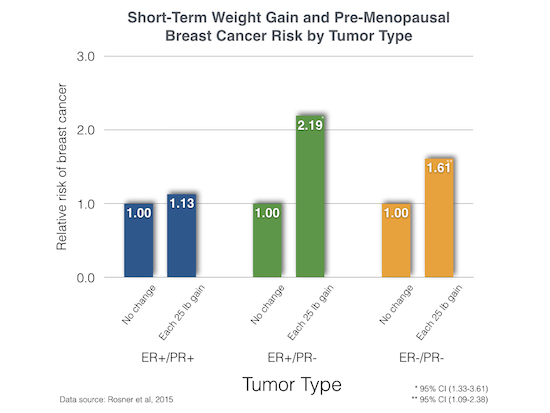
Though substantial weight gain is often something that happens over a relatively prolonged period, in the Nurses’ Health Study, we also assessed the potential impact of short-term recent weight gain on breast cancer risk (4). We looked at weight gain over 4 years, and the risk of cancer in the next 2 years. We found that short term weight gain increased the risk of premenopausal breast cancer, and that these risks were significant for two specific types of disease: ER+/PR- breast cancer and ER-/PR- breast cancer (see Figure 2). Compared to women who didn’t gain weight, the risk of ER+/PR- breast cancer was more than doubled with each 25 pounds gained over that period.

Figure 2

Why does this matter? Substantial weight gain in premenopausal years increases the risk of hard to treat breast cancer, such as ER-/PR- disease, and also conveys future cancer risk as women pass through into the postmenopausal years 4. While weight loss after menopause can substantially reduce breast cancer risk, perhaps by up to a half (see Figure 3) (3), avoiding weight gain is clearly preferable. Weight, once put on, can be hard to lose, and maintaining a lifelong healthy weight has the added benefits of improving quality of life and lowering the risk of many other cancers as well as other serious diseases, like diabetes, heart disease, stroke, and osteoporosis (5).
Figure 3

Prevalence and disparities in weight status

Weight gain, unfortunately, is a very common problem in the United States, and it is not one borne equally across society (6). While black and white boys show similar weight distribution from ages 5 to 17, black and white girls differ in weight starting around age 9, with black girls on average heavier than white girls. This difference continues to increase through age 17.

Weight gain through childhood and adolescence may reflect external circumstances – which can include factors like affordability of healthy food choices, availability of safe places to play/exercise, exposure to marketing of unhealthy foods, and parent/guardian time-constraints (7,8).

And many of the disparities in weight distributions in youth – and the social and physical environmental factors that help contribute to them – continue through the adult years.

Our recent analysis of national United States data (National Health and Nutrition Examination Survey) shows that African American women have had an overall higher prevalence of overweight and obesity compared to non-Hispanic white women over the past 20 years (see Figure 4) (9). The data also show that the prevalence of overweight and obesity in African American women exceeds that of non-Hispanic white women when looking at adults under age 50 and age 50 and over (see Figure 5). To be heavier as a group before age 50 implies continuing excess weight gain through the premenopausal years.

Figure 4 - Overall changes in weight status over the past 20 years. Source: Yang and Colditz, 2015

Figure 5 - Weight status by age – under age 50, age 50 and over. Source: Yang and Colditz, 2015

In a recent paper in the American Society of Clinical Oncology’s ASCO Post , I wrote about the excess rate of hard to treat breast cancers in African American women and that such hard to treat tumors are one likely reason that African American women experience higher rates of breast cancer mortality than do non-Hispanic white women. And growing data, already discussed, suggest that unhealthy weight may be a contributor to the risk for such hard to treat cancers.

So, while overweight is a key driver of breast cancer risk and poorer outcomes for all women, particular emphasis is needed on efforts that narrow the weight status and health disparities seen between races and ethnicities, improving outcomes across the board.

To successfully tackle the issue of overweight in such a way will require political will and multidisciplinary efforts that are focused not just on individual behaviors but also on the important physical, social, and healthcare environments that can be key barriers to or facilitators of individual actions on diet and physical activity.

It is a tall order but one certain to pay off many times over.


References

1. International Agency for Research on Cancer. Weight Control and Physical Activity. Vol 6. Lyon: International Agency for Research on Cancer; 2002.

2. Chan DS, Vieira AR, Aune D, et al. Body mass index and survival in women with breast cancer-systematic literature review and meta-analysis of 82 follow-up studies. Ann Oncol. 2014.

3. Eliassen AH, Colditz GA, Rosner B, Willett WC, Hankinson SE. Adult weight change and risk of postmenopausal breast cancer. JAMA. 2006;296(2):193-201.

4. Rosner B, Eliassen AH, Toriola AT, et al. Short-term weight gain and breast cancer risk by hormone receptor classification among pre- and postmenopausal women. Breast Cancer Res Treat. 2015;150(3):643-653.

5. Willett WC, Dietz WH, Colditz GA. Guidelines for healthy weight. The New England journal of medicine. 1999;341(6):427-434.

6. Rosner B, Prineas R, Loggie J, Daniels SR. Percentiles for body mass index in U.S. children 5 to 17 years of age. J Pediatr. 1998;132(2):211-222.

7. Swinburn BA, Sacks G, Hall KD, et al. The global obesity pandemic: shaped by global drivers and local environments. Lancet. 2011;378(9793):804-814.

8. Blumenthal SJ, Hoffnagle EE, Leung CW, et al. Strategies to improve the dietary quality of Supplemental Nutrition Assistance Program (SNAP) beneficiaries: an assessment of stakeholder opinions. Public Health Nutr. 2014;17(12):2824-2833.

9. Yang L, Colditz GA. Prevalence of Overweight and Obesity in the United States, 2007-2012. JAMA Intern Med. 2015.