Showing posts with label weight gain. Show all posts

Friday, March 23, 2018

Weighty Matters: The Obesity Epidemic Keeps Advancing

A new federal analysis shows that the adult obesity epidemic in the United States keeps on getting worse.  Between 2007 and 2016, the percentage of the adult population that was obese increased from an already very high 33.7 percent to a staggering 39.6 percent.  And the rate of those severely obese increased from just under 6 percent to close 8 percent over the same time period (see figure).  Severe obesity is defined as a body mass index (BMI) of 40 or higher, which translates to someone 5'8" weighing 265 pounds or more.


The one silver lining of the new report is that obesity in youth appears to be staying relatively steady.  While rates of obesity in ages 2 - 19 years increased from 16.8 percent in 2007 to 18.5 percent in 2016, it was not to a degree that reached statistical significance.  

Still, the continuing trend in adult obesity remains extremely troubling - not only for individuals who suffer from increased risk of cancers, stroke, diabetes, heart disease, and lower quality of life but also for the nation as a whole that experiences higher health care costs and lost productivity. 

These numbers show us how important it is to keep up our efforts to address this issue - and in new and innovative ways.  We live in what many classify as an "obesigenic" society.  Technology, workplaces, and infrastructure are actively designed to cut down on physical activity. And ads and other cues that surround us encourage us to overeat - and often with unhealthy choices. 

Without diminishing the important innovations we've experienced as a society over the past decades, we need to harness our energy to address such unhealthy outcomes by making important changes at all levels of society - from schools and workplaces to neighborhoods and individuals to local and federal policies.  


Wednesday, January 24, 2018

In Practice: What I Learned from Weighing Myself (Almost) Every Day

by Hank Dart

In my many years of writing about and promoting healthy behaviors, I’m happy to say that I’ve at least tried to put into practice just about everything I’ve espoused. Of course, like many people, my success at doing so can be uneven. Some behaviors I do pretty well with - like exercise, olive oil, and fruits & vegetables. And some I admittedly struggle with - like, whole grains and added sugar.

But there’s one behavior I've written about a great deal but have never actually done myself. Regular weighing.  Stepping on the bathroom scale every day (or every week) and logging my weight.

Studies show that regular weighing can be a good tool for maintaining weight, especially in those who have lost weight and are working to keep it off. Because weight gain can creep up on people - a pound here, two pounds there - it's pretty easy to step on the scale after some months or years away and be surprised at the number staring up at you. Regular weighing can keep such jolts at bay and help us make small adjustments to how much we eat and how active we are so we can keep moving toward our long-term weight goals – whether it’s keeping weight steady or trying to slowly lose some weight.

And weight is a struggle for most of us in the United States.  Over two-thirds of the population is overweight or obese, and this has a huge impact on the health of individuals and the nation.  Being overweight is a cause of numerous cancers as well as heart disease, stroke, and diabetes.  It can also hamper mobility and overall quality of life.

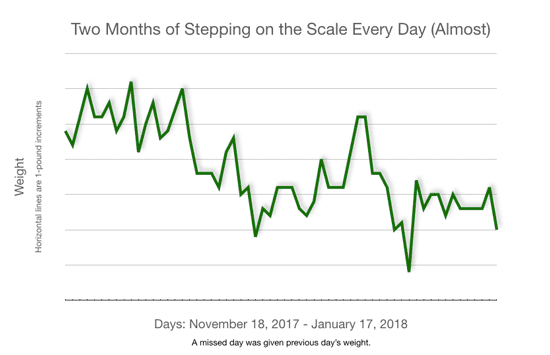
So, after years of writing about the benefits of regular weighing, it was time to put down my keyboard and hop on the scale.  On November 18, the week leading into Thanksgiving, I weighed myself for the first time in probably nine months and began my (almost) daily weighing program (see figure).

What did I discover over my first two months of weighing? Here are some highlights:
Routine. Creating a routine makes things easier. Decide when and where you’re going to weigh yourself and really try to stick to it. I chose first thing in the morning – bleary-eyed and before coffee. If you miss some days, don't stress. While I stepped on the scale on most days, I missed 11 weigh-ins over two months. Some days I was feeling too busy to do it.  Some days I just didn't feel like. But overall, I tried to keep missed days as outliers and used them as a time to remind myself that this was a goal I wanted to work on.   When it comes to routine and consistency, find what works best for you. Different approaches work for different people.
Fluctuations. Day-to-day there will be fluctuations in weight. Sometimes up. Sometimes down. That’s natural. Two days after my first weigh-in, my weight was up about two pounds and stayed there on-and-off for the next 10 days. And about 30 days after that, I had a seven-day stretch where my weight changed by over four pounds. And I had no real explanation for either of them. As you get used to these natural ups and downs, you learn to place less importance on them and see them as part of your larger trend. 
Mindfulness. One of the most important parts of daily weighing, I found, was simply the act of stepping on the scale. No matter what number came up, it helped me keep my goal in mind. This doesn’t mean you should obsess about weight. But daily weighing can help you be a bit more mindful about your weight goals throughout the day. The world that surrounds us is filled with cues that entice us to eat – a lot. Daily weighing can be one way that helps counter that influence, helping us be more mindful of our goals and keep an eye on making healthy choices. 
Frustrations. Daily weighing can have some frustrations, especially when the numbers don’t seem to reflect the work we’ve been putting in. In those times, it’s important to stay positive.  By weighing yourself you're gathering information that can help you adjust your approach and successfully work toward your long-term health goals. 
Big picture. While weight is important, it’s not the only important aspect of health. Weighing yourself every day shouldn’t become an obsessive exercise in working toward unrealistic or unhealthy weight goals. Rather, it should be a tool that helps us work toward sensible and healthy weight goals that we can maintain over time. A healthy weight should be one part of an overall healthy lifestyle that includes a good diet, regular exercise, not smoking, and other healthy behaviors.

Monday, July 10, 2017

Boston Nutrition Obesity Research Center: 25 Years of Progress on the Links Between Overweight and Cancer

At today's annual symposium of the Boston Nutrition Obesity Research Center (BNORC), CNiC's Dr. Graham Colditz delivered a plenary session talk reviewing BNOCR's 25-year contribution to the science on obesity and cancer.

A past associate director of the Center, Colditz also paid tribute to groundbreaking nutrition researcher, George Blackburn, who passed away in February 2017 and played a key leadership role in establishing BNORC and fostering its important work. In addition to discussing Blackburn's role in advancing such fields as obesity economics, chronic disease prevention, and bariatric surgery, Colditz also recounted how Blackburn's driven nature also translated to his driving habits on Boston's infamous roads, with oftentimes exciting results.
"George offered to drive me back to my office on Longwood Avenue," said Colditz. "I accepted, and am pleased to say I survived a dash through city traffic with George at the wheel, a harrowing experience I expect many other here have shared over the years." 

Despite the stress his driving may have caused in others, Blackburn, and BNORC in general, did a great deal to help shape our current understanding of health and prevention.  Key studies showed the important role of adult weight gain on the risk of heart disease and breast cancer - and that BMIs within the upper end of the "normal" weight range could still significantly increase the risk of diabetes and heart disease.

Findings like these played an important role in shaping national health policy, possibly most notably with the practical recommendation in the 1995 Dietary Guidelines for Americans that adults should "maintain or improve weight," rather than simply focus on trying to achieve a healthy weight, which is not practical for many people. Simply avoiding future gain could have large benefits across many types of diseases and across the nation.

Other advances the work of BNORC played a role in was in identifying links between overweight and cancer, with much of this work foundational to a 2016 International Agency for Research on Cancer (IARC) report detailing the strong association between excess weight and 13 different cancers, including: breast, colon and rectum, endometrial, esophageal (adenocarcinoma), gallbladder, gastric, kidney (renal cell), liver, multiple myeloma, ovary, pancreas, and thyroid.

As our understanding of the weight-cancer link grows, said Colditz, we may in the future be better able to personalize lifestyle recommendations for people - to help them lower their future risk of cancer or improve their prognosis as cancer survivors. As well, we may better be able to understand how to allocate resources across the population for maximum impact.

# # #

"BNORC: Contribution over 25 years to evidence on obesity and cancer."- Graham A. Colditz, MD, DrPH. Boston Nutrition Obesity Research Center Annual Symposium and Tribute to George Blackburn, MD PhD, Boston, MA (July 10, 2017).

http://www.cancermedia.org/slides/BNORC071017.pdf

Thursday, March 23, 2017

12 Little Things That Can Put a Hitch in Your Efforts to Keep Weight in Check - And Ways to Fix Them


by Hank Dart

Even in the middle of the roiling media cycle we're in, diet has still managed to break through and make headlines the past couple weeks. Probably the biggest recent story was the release of a paper in the Journal of the American Medical Association that found that around 40 - 50 percent of deaths in the United States from heart disease, stroke, and diabetes could be linked to unhealthy eating. Big culprits were eating too much sodium and processed meat, and not enough nuts, seeds, and fish rich in healthy fats.

Following on the heels of this was a paper in the journal Cancer Causes and Control by Isabelle Romieu of the International Agency for Research on Cancer (IARC), which detailed the key drivers of energy imbalance that lead to obesity. Energy imbalance, when it comes to weight gain, simply means consuming more calories than you need, which over time can lead to becoming overweight and possibly obese.

And, as many of us have frustratingly found, it doesn't take too many of these extra calories to put on weight, something Romieu and her co-authors highlight -
"Very small deviations from energy balance, on the order of 1 - 2% of daily energy intake, can result in large long-term change in body weight (~20kg)[Ed: ~44lbs]."
For a moderately active adult woman, for example, 1 - 2 percent is only about 20 - 40 extra calories a day. That's the splash of cream in a morning coffee, three ounces of sugary soda, or half a small cookie. Or looking at it from the other end, that's the calories burned by walking less than half a mile. Not much at all.

Clearly, the little things we do in relation to how we eat and how active we are can really matter, especially over time. So, let's take a look at some of the little things that can put a hitch in our best efforts to keep in energy balance.

 Most likely, we all have at least one or two -- and probably more -- that we do regularly. The good news: because they're little, or at least little-ish, they're sometimes not too hard to start to tackle. 

Why not begin today?

Eating too fast
It's a go, go, go world these days, and that mindset can transfer to our eating, too. But eating food fast can easily lead to overeating because our minds and stomachs need some time to synch up. You can quickly down two hot dogs, a shake, and large fries before your mind has had a chance to register the first hot dog and tell you you've had enough. Before you know it, you feel stuffed and may have eaten a 1,000 calories more than your body actually wanted.

The fix: Simply try to slow down at each meal. Take time between bites. Enjoy your food. This slower pace can put your stomach and mind in better synch and help you feel satisfied with less food.


Ordering "the works"
Steer clear of ordering anything with "the works." Along with "stuffed crust" and "extra whip," "the works" are two terrible words to utter when you're working to keep calories in check. Whether on a potato, hamburger, or dessert, "the works" is usually just a vehicle for extra calories you may not even enjoy all that much.

The fix: Try low-calorie toppings instead, like fresh fruit, tomatoes, or salsa.


Being swayed by advertising
Most food companies want to get us to eat and drink - and the more the better. And they spend billions of dollars a year on advertising to get us to do just that. So, it's important to try to develop a bit of media savvy when it comes to advertising, so we can make clear, objective choices about the food we eat.

The fix: When you see a food ad, just take a moment and ask yourself: Why is the company paying for this ad? Is the ad a true depiction of what buying and eating the food is like? Is the food a healthy choice for me and my family? Most of the time, the answers will speak for themselves.


Driving a lot
Many of us need to spend way too much time in cars -- or on buses or subways. It's just a fact of life. We have to get to and from work, pick up the kids, and run errands. But many times, we also take the car or other transportation when we could just as easily walk or ride a bike. And this cuts out a great opportunity to easily add some physical activity to our days.

The fix: If it's safe, try to do some errands on foot or by bike a couple times a week. Then, build from there.


Eating mindlessly
Most of us do some amount of automatic eating -- eating without really thinking about it because there's food in front of us, our favorite TV show is on, or it's a certain time of day. But such mindless eating, usually when we're not even hungry, can add a lot of extra calories to our days.

The fix: Just take a moment and think before you eat. Ask yourself: Am I actually hungry? If you're not, try to do something other than eating for while. Go for a quick walk, play a game, even do some chores or errands you've been putting off.


Throwing in the towel 
Set-backs are natural. We're human. But don't let set-backs frustrate you into abandoning your health goals - even for a day. Yes, you ate five pink cookies you hadn't plan to and missed your workout. That's OK. Keep the long view.

The fix: Stay positive and know that health is a journey. And journeys are rarely straight lines to a destination. There can be twists and turns. Just get back on track and keep moving forward -- knowing you can get where you want to be.


Drinking calories
A lot of beverages are packed with calories -- sugary soda, sweet tea, and many types of blended coffee drinks. On top of this, it's been shown that our bodies don't register these liquid calories as readily as those from food. So, we often don't compensate for beverage calories by eating fewer food calories. The result: extra calories in our day.

The fix: Choose water or unsweetened tea and coffee instead of sugary drinks. Start with just one or two days a week, but eventually try to get down to zero sugary drinks. It's probably not as hard as you think.


Being too refined
Being refined in life is wonderful, but eating too many refined grains is not. Refined grains -- which make up foods like white bread, white rice, and regular pasta -- have had most of their fiber and nutrients stripped out in processing. Diets rich in less-processed whole grains -- like, 100% whole wheat bread, brown rice, and old-fashioned oatmeal -- have been shown to help keep weight in check.

The fix: Try to start buying more whole-grain foods. There are a lot of options these days. Look for foods with "whole" or "whole-grain" as a first ingredient and not too much sugar (7grams/serving or less).


Avoiding the bathroom scale
Not many people enjoy stepping on the bathroom scale. But avoiding it for long periods can lead to unwelcome surprises. Weight gain has a way of sneaking up on people. An extra pound here and an extra pound there can really add up over time. Stepping on the scale weekly, even daily, can help us keep track of our weight and adjust how much we're eating and how active we are.

The fix: Set a date with your scale -- every Tuesday at 7am, say -- and keep it. Want to go a step further? Keep track of your weight with a paper log or smartphone app.


Ignoring calorie labels
One thing's clear by now: calories matter. And although it's not essential to painstakingly track how many calories are in the food we eat, it can be helpful to have a general idea. Some meals, especially when we're eating out, can have a surprisingly large number of calories, at times bordering on a whole day's worth.

The fix: Many restaurants and fast food places post calorie-counts on menus, so they're pretty easy to find. Given them a quick read before you order, so you know what you're getting, and adjust if you need to.


Eating out for lunch - a lot
Eating lunch out -- whether at a restaurant, fast-food place, or food truck -- is often fun, tasty, and easy. But there can be downsides, too. It can be unhealthy, expensive, and calorie-packed.

The fix: Try to brown-bag it more often. Packing your lunch with healthy foods, in modest portions, means you're more likely to keep calories in check.


Waiting 'til tomorrow
Trying to get on a healthier path -- whether it's walking more or eating more fruits and vegetables -- isn't always easy. So, it's natural to want to put things off. And a day here or a day there may not make much difference, but the more you put things off, the more likely you are to keep putting things off. The sooner you get started on a healthier path, the sooner it'll become second nature to you, and the sooner you'll start getting benefits.

The fix: Try a new healthy behavior today, no matter how small it may seem. It can be buying a banana at lunch or walking to a bus stop that's further away than usual. Then keep it up, building over time with other healthy changes. 

You've got this.

Tuesday, February 28, 2017

Compelling Evidence on Overweight & Cancer Compels Action

An editorial published in today's British Medical Journal (BMJ) by Cancer News in Context's Yikung Park and Graham Colditz makes the strong case that it's time to take action to combat weight-related cancers.  The editorial addresses a new "umbrella review," also published in the BMJ today, that found strong evidence that overweight and obesity increases the risk of 11 types of cancer.

The review, by Maria Kyrgiou and colleagues, collected and analyzed over 200 systemic reviews and meta-analyses that included data on 36 different cancers. Of these, the researchers found strong links between various measures of overweight and an increased risk of cancers of the esophagus (adenocarcinoma), stomach, colon, rectum, biliary tract, pancreas, breast, endometrium, ovary, and kidney, as well as multiple myeloma.


In their editorial, Park and Colditz, point out key differences between the conclusions of the umbrella review and a 2016 International Agency for Research on Cancer (IARC) report, which Colditz headed, and which concluded that there is sufficient evidence that overweight and obesity increased the risk of 13 types of cancer. Differences between the findings of the two papers, Park and Colditz write, could be related to differences in the type of studies included in the analyses and the methods used to assess the studies that were included. Among other things, the:
"IARC report clearly demonstrated the importance of assessing the quality of each meta-analysis, including search strategy, inclusion and exclusion criteria, and data extraction, which is often outside the scope of an umbrella review"
Despite some important differences between the IARC report and umbrella review, the findings of the new review further bolster the evidence that overweight and obesity cause cancer. As Park and Colditz write:
"Though some specifics remain to be worked out, the unavoidable conclusion from these data is that preventing excess adult weight gain can reduce the risk of cancer."
The American Institute for Cancer Research estimates that overweight and obesity cause over 130,000 cancers each year in the United States, and millions annually lose their lives to weigh-related cancers worldwide. As the obesity epidemic continues largely unabated, the tragedy of these numbers will only worsen if we stay on the same course. Among other efforts to address the issue, Park and Colditz conclude, we need to tap the currently unmet potential of the healthcare system:
"Given the critical role of healthcare providers in obesity screening and prevention, clinicians, particularly those in primary care, can be a powerful force to lower the burden of obesity related cancers, as well as the many other chronic diseases linked to obesity such as diabetes, heart disease, and stroke. The data are clear. The time for action is now."

Tuesday, June 14, 2016

Large-Scale Problem: Obesity Rates Still Increasing in Certain Groups


by Hank Dart

The course of the obesity epidemic in the United States has been so bad for so many years that even minor victories have been cause for celebration. But despite some bright spots in the most recent Centers for Disease Control and Prevention reports on national rates of obesity (on adults, on youth), there's little celebrating going on.  The reason?  Some striking milestones in the rates of obesity in both women and teenagers.

The rate of obesity in US women -- which for most of the past decade rested around 35 percent -- has now surpassed 40 percent -- rising from 35.7 percent in 2005/6 to 40.5 percent in 2013/14, the most recent years for which there are data. And this overall number doesn't tell the complete picture, as the burden of obesity isn't shared equally across all groups.  The rate of obesity is around 38.2 percent in white women, 46.9 percent in Hispanic women, and 57.2 percent in black women.  Asian women have the lowest rate, at around 12.4 percent.

While the numbers in men are concerning as well, they've stabilized somewhat over the past decade, bouncing around the mid-30s, with the most recent report finding that 35 percent of men in the United States are obese. As with women, the numbers for men vary by age, with Asians having the lowest rate (12.6%) and blacks the highest (38%).

The new numbers for youth are not quite as striking - but remain concerning as well.  They show that over the past 25 years the rate of obesity in adolescents and teenagers has nearly doubled -- from 10.5 percent to 20.6 percent -- with the overall rate of obesity in youth ages 2 - 19 years old now at 17 percent, up from 10 percent in 1988.

There are, however, two positive trends in younger kids, with rates of obesity dropping since 2004 in 2 - 5 year olds and leveling off since 2008 in 6 - 11 year olds.

The overall picture of obesity in America, however, can be quite discouraging, even for the optimists who tend to work in public health. The epidemic began over two decades ago, and no efforts so far have been able to make real strides in reversing it. And the health, quality of life, and fiscal implications are enormous.

In a recent Viewpoint in the Journal of the American Medical Association, David Ludwig, MD of Harvard Medical School and the New Balance Foundation Obesity Prevention Center writes that the latest evidence may support predictions that the obesity epidemic and its health consequences may begin to shorten life expectancy in coming generations. While advances in the treatment of obesity-related chronic diseases like heart disease, diabetes, stroke, and cancer have kept mortality rates of these disease relatively stable or on the decline, a new provisional report on death rates suggests that mortality rates may now be increasing for some diseases.  The obesity epidemic could be creating more disease, and more serious disease, that advances in treatment can no longer keep up with.

Making progress against the epidemic is going to be essential if we are to help prevent growing rates of disease in the years and decades ahead.

In addition to bolstering research on the causes and prevention of weight gain, we need to support efforts that help people make and maintain healthy food and activity choices.  As with the fight against tobacco, this means multi-pronged, multi-layered approaches - such as improved food and activity offerings in schools and workplaces, taxes on unhealthy foods, subsides for healthy foods, widespread communication campaigns, and infrastructure that allows people to easily and safely fit activity into their days.  The social, financial, and structural environment that surrounds us is key to making and sustaining healthy behaviors.

Stemming the tied of weight gain in the US will not be easy, but it's essential that as a society we garner the will to put in place a concerted effort that will benefit current and future generations.

#          #          #


See also:

Other Cancer News in Context posts addressing cancer, chronic disease, and weight.

Friday, January 29, 2016

Weighing Evidence: Obesity and Breast Cancer Risk Across Life


by Hank Dart

In a paper published yesterday in the journal Science Translational Medicine, Cancer News in Context's Graham Colditz and Washington University researcher, Kelle Moley, detail the important role that overweight and obesity play in the development of breast cancer.

Looking at wide-ranging evidence at all periods of life -- from gestation to the years after menopause -- Colditz and Moley show that despite some targeted times in youth, excess weight increases breast cancer risk over the course of a woman's life.
In the womb.  Though there is still a great deal to learn about the impact of mother's weight on her daughter's adult risk of breast cancer, larger weight gain during pregnancy has been linked with a higher risk of breast cancer in daughters.  The more a daughter weighs at birth has also been found to increase risk.   
Infancy and childhood.  Overweight in this period of life likely has a mixed impact on adult breast cancer risk.  It can lower breast density as well as slow the rate that girls grow to their maximum height -- each of which can reduce breast cancer risk.  At the same time, being overweight in childhood can lead to earlier first periods (menarche), which is an important breast cancer risk factor. 
Adolescence.  The lower risks linked to childhood overweight likely continue through the adolescent years.  
Premenopause.  While the protection against breast cancer from youth overweight likely persist, adult weight gain in the years before menopause can increase risk, offsetting and likely surpassing protection from youth. 
Postmenopause.  Evidence has long-shown that overweight and weight gain after menopause increases the risk of breast cancer.  
Though there are a number of possible reasons why overweight influences breast cancer risk, it's impact on hormone levels and related responses at various stages of life is a major part.

Despite some periods in life where overweight may have a beneficial effect on breast cancer risk, its overall impact is certainly negative.  And the best approach is to maintain a healthy weight throughout life - from childhood on.   Weight often tracks children and adults throughout life.  Overweight youth are more likely to become overweight adults, and overweight young adults are more likely to be overweight in later life.

For adults who are overweight, though, there is good evidence that losing weight and keeping it off can significantly lower breast cancer risk as well as the risk of other important diseases, like heart disease and diabetes.

Here in Cancer News in Context, we've previously highlighted some straightforward -- and a few off-kilter -- tips for keeping weight in check, most recently during our series, 9 Days of Practical Steps to Prevent Breast Cancer. Perhaps less familiar for many is knowing how best to approach weight and breast health issues of their children.  The focus should be on helping children be active, eat a largely plant-based diet, and avoid tobacco and alcohol.  Hardest for many parents is simply recognizing if their child has a weight issue -- so making an effort to understand where their child falls on growth charts can be really important in helping them maintain a healthy weight in their youth, and beyond. A good place to start for questions about childhood weight is the CDC’s BMI Calculator for Child and Teen. For more on breast health approaches for youth, see The Power of Youth: Beginning Breast Cancer Prevention in Childhood.

Thursday, December 10, 2015

Unwrapping Holiday Weight Gain - and Ways to Prevent It


by Hank Dart

We’re in the middle of it now. The holiday season – that wonderful and stressful five-week stretch from Thanksgiving to New Year’s where at every turn, there seems to be food. And not just everyday food, but food of such amounts and enticing types that it can feel nearly impossible at times to refuse them.

Add the long nights, cold weather, and busy schedules that throw us off our normal exercise routines, and the stage can be set for entering 2016 with our clothes fitting just a bit tighter than they did earlier in the fall.

If this scenario feels all too familiar from holidays past, you can find some comfort in knowing you’re not alone. Studies have found that holiday weight gain is a very real thing that many people struggle with.

How much weight gain are we talking about?
Though it can vary greatly from person to person, typical weight gain over the holidays is around 1 to 1.5 pounds. But, many people gain considerably more, on the order of 5 pounds or more, says Dr. Samuel Klein, William H. Danforth Professor of Medicine and Nutritional Science at Washington University School of Medicine.

And the weight put on over the holidays makes up a large proportion of the weight that most people gain every year. A study in the New England Journal of Medicine found that of the weight that participants on average gained over the course of a year, just over half was put on during the holidays (1).

It’s like the party guest that never leaves. And that’s what makes holiday gains problematic, according to Klein: “People usually do not lose the weight they gain during the holidays and it is a major cause of yearly weight gain and increasing body weight in the United States.”

Of course, the amounts don’t sound like anything that’s really worth worrying about. A pound here. A pound there. But weight gain has a way of silently creeping up on people. And over the years, it can turn into noticeable amounts that can have a negative impact on both health and quality of life.

Assuming a gain of just one pound per year, for example, someone who is 5’9”, weighs 165 pounds, and has a “healthy” BMI of 24 would be well into the middle of the “overweight” category after 20 years (BMI of 27) and then crest into “obesity” after 40 years (BMI of 30). With the large majority of people in the United States already overweight or obese, these movements can happen even faster, not only because the starting BMI is higher but also because holiday weight gain is often larger in those who are already overweight.

“In general, [holiday] weight gain is proportional to BMI. People with higher BMI tend to gain more weight,” says Klein.

And findings from the New England Journal of Medicine study provide a good example of this. Of those participants who were overweight, 11 percent experienced “major holiday weight gain” of 5 pounds or more. In obese, participants, the proportion rose to 17 percent. In healthy weight participants, only 5 percent experienced a major gain.

How many extra calories does it take?
So, how much overeating does it take from Thanksgiving through New Year’s to cause the typical holiday weight gain? Surprisingly little it turns out.

In a paper in Physiology & Behavior, Dale Schoeller of the University of Wisconsin ran some numbers and concluded that it took just 55 extra calories a day to build up to the average holiday gain of about a pound (2). That’s around the amount in that cookie you grabbed on the way out the door at your work party or that dollop of whip cream you put on your pie.

What can we do about it?
Keeping weight in check is hard any time of year, let alone over the holidays when we’re thrown off our regular routines. But it’s far from impossible. A lot of people come through the holidays without gaining any weight, and some even harness the change in schedule to their advantage and are able to lose a few needed pounds.

Looking at all the meals, parties, and other holiday-themed gatherings that are part of the Thanksgiving to New Year’s season, there are some practical approaches that can help us keep excess calories, and weight gain, at bay.

Klein offers these practical tips for holiday events:
“Portion control”
One of the best ways to keep calories in check is to cut back on portion size. We’ve gotten really used to huge meals, huge snacks, and huge drinks. Put smaller amounts of food on your plate, or try simply choosing a smaller plate. Most of the time you’ll find that smaller amount is all you really wanted.

“Eat before going to parties so that you are less hungry”
Coming to a party when you’re feeling ravenous can lead to overeating. The better approach is to have a healthy meal or snack at home and then head to the festivities. This way, all those alluring high-calorie choices won’t hold quite as much sway.

“Stay as far away as possible from the food tables at parties”
This falls into the “out-of-sight., out-of-mind (and stomach)” category. Just giving yourself some distance from the food at an event can make it less likely that you’ll grab food mindlessly, even when you’re not hungry.

“Minimize alcohol intake”
Alcohol is a big part of many holiday gatherings, which is fine in moderation, of course. It’s a time of celebration. But, if you’re watching calories, it’s probably best to keep drinking to a minimum. Alcohol is an appetite stimulant and can quickly disrupt your best-laid plans to avoid eating too much.

“Keep a low-calorie or zero-calorie drink in your hand”
From eggnog to wine to sugary soda, the holidays are filled with high-calorie (and often alcoholic) beverages that can contribute to extra calories. When you get to an event, pick up a low-calorie drink – like fizzy water, coffee, or diet soda – so your host, or best friend, isn’t tempted to give you a high-calorie option.

“Bring a low-calorie dessert or food”
It’s good form to bring a small gift when you’re invited to a dinner party. And most of us default to a bottle of wine or six-pack of beer or sugary soda. If you’re watching calories, try bringing a low-calorie appetizer or dessert option instead – like a platter of vegetables or fresh fruit with a low-calorie yogurt dip. It may feel a little self-serving, but you can bet that others will appreciate it, too.

On top of these special tips for holiday events, it’s also important to keep up with the tried-and-true weight control strategies that apply year-round: exercise every day; keep screen time to a minimum; choose a diet rich in fruits, vegetables, and whole grains; and try to be aware of how much you’re eating. In the end, it’s the calories we burn and the calories we eat that really matter.

Crazy as they can be, the holidays always hold a special place on our calendars. With a little planning, and a few simple steps, we can keep them from making a lasting mark on our waistlines as well.


For more healthy tips - for the holidays and year-round, visit
8IGHT WAYS to Stay Healthy and Prevent Cancer 
Your Disease Risk
Siteman Cancer Center - Healthy Holiday Cookbook 


References

1. Yanovski JA, Yanovski SZ, Sovik KN, Nguyen TT, O'Neil PM, Sebring NG. A prospective study of holiday weight gain. N Engl J Med. 2000;342(12):861-867.

2. Schoeller DA. The effect of holiday weight gain on body weight. Physiol Behav. 2014;134:66-69.


Wednesday, October 21, 2015

9 Days of Practical Steps to Prevent Breast Cancer: Day 1 - Keep Weight in Check

We know. You've been awash in pink for the past three weeks.  So you're forgiven if you're a bit tired of reading about breast cancer and Breast Cancer Awareness Month.  But, we at Cancer News in Context hope to help you work past any late October doldrums by closing the month out with an engaging series that emphasizes the very positive message that breast cancer is preventable -- and with pretty simple behaviors.

For the next nine days, we'll highlight key steps and practical tips that can help women lower their risk of the disease.   It may be hard to believe, but evidence shows that half or more of all breast cancers could be avoided by things like exercising, keeping weight in check, and avoiding too much alcohol.  

This series will be your practical guide to putting these behaviors into practice and boosting your overall breast health.  So, let's get started. 


_  _  _  _

Day 1 - Keep Weight in Check

OK. This message is easy to tune out because it gets said so often, but maintaining a healthy weight is a great goal for everyone. Two-thirds of all women in the United States are either overweight or obese. And excess weight is a key contributor not only to breast cancer risk but also to the risk of heart disease, stroke, and diabetes.

So, what should be your weight goal? The first goal should always be to maintain your weight – to keep it steady. Weight gain can be sneaky. It creeps up on most people. One pound here, another pound there. Then you step on the scale and suddenly realize you’ve put on 20 pounds over the past 10 years. This happens to a lot of people, so the best thing you can do is try to keep from gaining weight. This applies pretty much to all women, no matter what their current weight.

If you’re overweight, the next goal is to try to lose weight. Losing just 5 – 10 pounds and keeping it off can significantly lower the risk of breast cancer, and it’s a very realistic goal. Ideally, the next goal is bringing your weight down to a BMI between 18.5 – 23 (BMI calculator). For a woman who is 5’ 5”, that’s a weight between 111 – 138 pounds.

Losing weight isn’t always easy, but it’s far from impossible, and some practical tips can really help you succeed.

Tips and Tricks - Weight

Be physically active every day. Regular activity is one of the best ways to keep weight in check. Choose things you enjoy that get you moving and shoot for at least 30 minutes a day. Studies show that 60 minutes or more is even better for weight loss.

Limit time in front of the TV and computer. Screen time – the phrase given to time spent with our TVs, computers, phones, and tablets – is a double whammy when it comes to weight and health. Not only does it up the amount of time we spend each day in complete inactivity, but it also makes it more likely that we’ll overeat (especially unhealthy foods) while we’re sitting in front of those screens. Shoot for under two hours of non-work screen time each day. Less is even better. Zero is ideal.

Eat a diet rich in fruits, vegetables, and whole grains. Eating a lot of plant-based foods can help keep appetite and weight in check. Not only are they very filling but they also keep at bay wild swings in blood sugar that make you want to eat – even if you’ve just had a big meal. On to top of this, there’s growing evidence that plant-based food can help lower breast cancer risk, outside of their influence on weight. Shoot for at least three servings of whole grains a day, five servings of fruits and vegetables, and keep red meat to a minimum.

Choose smaller portions, and eat more slowly. It can seem unlikely that eating food slowly and choosing smaller portions can help people eat less, but there are actually data to back this up. At the most basic level, eating slowly gives our stomachs time to tell our brain when we’ve had enough food. As competitive hot dog eaters will tell you, it takes about 10 - 20 minutes for the brain to register when the stomach’s full. If you eat too quickly, you can down a plate of food, grab more, and then down that before your brain knows what hit it. By then, you may have had twice as much food as you needed or even really wanted. So why not slow down and enjoy your food? You won’t even miss the extra food you’re not eating.

Choose water and keep sugary drinks to a minimum. Sugary drinks – like, sodas and energy drinks – can sure taste good, but they really do nothing good for you. They have little or no nutritional value, are packed with calories, and have been shown to increase the risk of obesity and weight gain. The best choice is to avoid sugary drinks completely and choose water instead. It can be a tough transition, but you don’t need to do it all at once. Each week, slowly cut back on sodas and energy drinks, and before you know it, you’ll be down to zero and likely not missing them at all. Keeping a water bottle handy wherever you go can really help. And be sure to keep 100 percent fruit juice in check as well. Though it’s healthier than sugary sodas, 100 percent juice is still packed with calories. Whole fruit is always a better choice. If you do drink 100 percent fruit juice, keep it to just 4 – 6 ounces a day.

Step on the scale every day. Yes. Every day. It may sound like a nightmare – confronting those pounds every morning – but research shows that your bathroom scale can be a great tool when it comes to losing weight and keeping it off. Weighing yourself regularly helps you avoid being surprised by creeping annual weight gain and can help you make necessary adjustments to stay on track to losing or maintaining weight. Perhaps surprisingly, weighing yourself every day can also let you know if you’re losing weight too quickly. Healthy weight loss is around a pound or two a week. Losing weight quicker than this – while initially exciting – can make it harder to keep weight off over time.

Find people who support you. You may be a rugged individual with a deep streak of independence, but when it comes to losing weight and keeping it off there’s some pretty good evidence that you may just want to surround yourself with people who support your efforts. It can be family, friends, or a weight loss discussion group, but the key is to find people who can not only provide practical support for weight loss – with recipes and other tips – but also emotional support and encouragement that help keep you on track and heading toward your goals. Many hospitals, medical centers, and recreation departments host weight loss support groups. Some commercial weight loss programs – like Weight Watchers – also have programs with support components. Online options exist as well.

_ _ _ _

Mindful weight loss

Stop. Read this. Now read this slowly. S l o w l y. Now take a slow deep breath in and count “one.” Take a slow breath out and count “two.” Now repeat this three times. S l o w l y.

You’ve just had a mindful moment. It’s a real rarity in today’s busy, smartphone-obsessed world. And that’s a problem according to some health experts, because there’s growing evidence that adding more mindful moments to our lives may be good for overall health by helping us eat better and keep our weight in check.

While mindfulness may sound somewhat mystical, it’s really just the practice of slowing down, turning off as many distractions as possible, and focusing on the thing that is happening in front of us right at that moment. By doing this we’re able to more deeply appreciate each experience in our lives and to be more in tune with both our mind and body.

Applying mindfulness to the way we eat can have many benefits. It can put us in better touch with our hunger cues, so we’re better able to realize when we’re actually hungry. It can help us know during a meal when it’s time to put the fork down because we’ve had enough. And it can even allow us to better appreciate healthy foods by focusing on the benefits they provide us.

Overall, mindfulness has a lot of potential to help people make better food and eating choices. And it’s really quite easy to get started. Begin with the mindful eating tips below. If these spur you on, and you’re interested in exploring things more in-depth, there are a number of mindful eating books by reputable doctors and researchers.

  • When you eat, just eat. Whether you’re eating alone or sitting down as a family, make sure all other distractions are limited. Turn off the television. Turn off the radio. Turn off the iPod. And definitely, get out of the car. This helps you to focus on the food and your experience of eating it. You’ll find you appreciate your food more and may actually feel like eating less of it.
  • Take a moment. When you sit down to a meal – wherever you are – take some time to just be silent before you start eating. You don’t need to do anything. You don’t need to think anything. All you need to do is sit quietly. Whether it’s for five seconds or 60 seconds, taking that little bit of time can be a great way to rest your mind and focus on the food you’re about to enjoy.
  • Eat slowly. Meals are meant to be savored – not rushed through. So slow down and enjoy your food; give your mind the chance to tell your stomach when it’s had enough.
  • Choose smaller portions. Part of being mindful is appreciating what’s in front of us. When we do this with our food, you may find that you get as much satisfaction from a plate of smaller portions than a plate (or two) of larger portions.
  • Appreciate water. There’s little in life that is more simple and straightforward than a glass of water. Take a long look at your next glass full and really appreciate it – what it looks like, what it tastes like, even what it feels like. It’s the healthiest thing you can drink and should be your main beverage choice every day. 

Next Steps - Weight

Looking for more in-depth information on weight? Here are some good sources:

National Heart, Lung, and Blood Institute
http://goo.gl/jkPZ1C

The Nutrition Source
http://goo.gl/ZrhaPB

Choose My Plate
http://goo.gl/PFjup2

Nutrition.gov
http://goo.gl/8HKGUp

Centers for Disease Control
http://goo.gl/Bfa1kU

Obesity Prevention Source
http://goo.gl/xrNBLz

Friday, June 27, 2014

Time on the Side: New Analysis Finds That to Eat Less - Eat Slower

Photo: Flickr/thomashawk

It probably comes as no surprise, but mom was right: We really shouldn't eat so fast.

Apart from the noise and the mess and the ill-effects on dinner table conversation, wolfing down food may have ill-effects on health as well.

A detailed new analysis in the American Journal of Clinical Nutrition shows that taking your time when you eat can substantially cut down on how much you eat.  And in today's world, where at least two thirds of the nation struggles with weight, this can have important implications.

The researchers performing the analysis combined the results from 22 separate studies looking at speed of eating and the amount of food eaten.  What they found was that those who ate their food slower ate less overall than those who ate their food faster, and apparently without feeling deprived.  Eating speed - fast or slow - had no effect on feelings of hunger, either right after a meal or three and half hours later.

We live in a society that often works against us when it comes to choosing healthy food and getting physical activity.  This can make it tough to lose weight, or even stay at the same weight. Yet, there are some simple steps we've promoted for a long time that can help with cutting back on calories and burning more calories through exercise.  Eating more slowly is one of these.  It may take some re-training of eating habits but in the end, its a pretty simple step  - just sit back, enjoy your food, and let time do the hard work.  In the end, we're likely to have eaten less - and to feel just as satisfied.

Try this and other tips to help keep weight in check: 

Choose smaller portions, and eat more slowly.  At the most basic level, eating slowly gives our stomachs time to tell our brain when we’ve had enough food.  As competitors at the Nathan’s Hot Dog eating contest will tell you, it takes about 8 minutes or so for the brain to register when the stomach’s full.  If you eat too quickly, you can down a plate of food, grab more, and then down that before your brain knows what hit it.  By then, you may have had twice as much food as you needed or even really wanted.  So why not slow down and enjoy your food.  You won’t even miss the extra food you’re not eating and that you didn’t even really want.

Fit physical activity and movement into your life each day.  Regular activity is one of the best ways to keep weight in check.  Choose things you enjoy that get you moving and shoot for at least 30 minutes a day.  And studies show that 60 minutes or more is even better for weight loss. 

Limit time in front of the TV and computer.  Screen time – the phrase given to time spent with our TVs, computers, phones, and tablets – is a double whammy when it comes to weight and health. Not only does it up the amount of time we spend each day in complete inactivity, but it also makes it more likely that we’ll overeat (especially unhealthy foods) while we’re sitting in front of those screens.  Shoot for under two hours of non-work screen time each day.  Less is even better.  Zero is ideal.  

Eat a diet rich in fruits, vegetables, and whole grains.  Eating a lot of plant-based foods can help keep appetite and weight in check.  Not only are they very filling but they also keep at bay wild swings in blood sugar that make you want to eat – even if you’ve just had a big meal.  Shoot for at least 3 servings of whole grains a day, 5 serving of fruits and vegetables, and keep red meat to a minimum.

Wednesday, April 23, 2014

Setting the Record Straight: The Impact of Diet on Cancer Risk

Photo: Flickr/Mike65444
An article posted earlier this week on the New York Times website stated that the link between diet and cancer risk was, in essence, a "myth."  And while links between diet and cancer are not as strong as those with some other chronic diseases, like heart disease, the article's conclusions demonstrate a lack of understanding of the science.

Yesterday, the American Institute for Cancer Research (AICR) - whose reports were referenced in the piece - posted their own response to the article detailing many links between diet and cancer, with AICR Director of Research, Susan Higginbotham, PhD, RD, stating: "If there’s one thing AICR’s research has shown, and continues to show, it’s that when it comes to cancer risk, diet does matter.”

As detailed in many of our scientific publications, consumer brochures, and risk assessment tools, we agree. Diet has an important impact on cancer risk.  Calories alone, and the weight gain they can cause, can impact at least 11 different cancers.  Too much alcohol is a key risk factor for colon and breast cancer - even at moderate levels of intake.  Fruits and vegetables can lower the risk of certain types of breast cancer.  Too much red meat - particularly processed meats - can substantially increase colon cancer risk.  Adequate calcium and vitamin D can lower colon cancer risk. And inadequate folate (a B vitamin found in many plant foods) has been linked to overall cancer mortality.  Strong associations with other dietary risk factors are quickly developing.

The message that cancer is a disease that can be prevented is extremely important.  It is also a message that is still just gaining momentum with both physicians and the public.  To greatly downplay the potential impact of diet on cancer risk is not true to the science and can lead to important missed opportunities for prevention.

--

Prevention Resources

Our 8IGHT WAYS® series is filled with great tips for improving your health and lowering cancer risk.
8IGHT WAYS to Stay Healthy and Prevent Cancer  
8IGHT WAYS to Prevent Breast Cancer 
8IGHT WAYS to Prevent Colon Cancer 
CANCER SURVIVORS' 8IGHT WAYS to Stay Healthy After Cancer

Our popular risk assessment tools are also great resources for learning about your risk and getting personalized prevention plans.
Your Disease Risk website 
Zuum - Health Tracker app for iPad

Thursday, November 15, 2012

Healthy Eating: Focus on Every Day, not Thanksgiving Day


Tara Parker-Pope wrote an interesting post yesterday on the New York Times' Thanksgiving Help Line about the commonly thrown around stat that the average person consumes 4500 calories in the course of Thanksgiving Day.  In the piece, she works at length itemizing what 4500 calories would actually look like – choosing many fat and sugar-laden calorie bombs – and although she was able to reach the 4500 calorie count, it took some doing, and would, she concludes, if actually consumed likely leave most people nauseous and gaseous and reaching for a full pack of antacids. 

The take away was that while some people certainly pack in the calories on Thanksgiving, it’s likely not to such an extreme as has become lore.  The vilification of Thanksgiving as a diet-killing, weight-packing annual affair may be undeserved.  Yet, the day does serve to highlight what most health and nutrition experts can agree upon: it’s not one meal, or one day, that’s important.  It’s how we eat on all the other days that matters.

For many of us, everyday has become a lot like Thanksgiving Day when it comes to how much we eat.  We’re surrounded by so many cues to eat – and so few avenues to activity – that we consistently eat more than we burn off, and the result is the creeping weight gain we see over time. 

Certainly, the holidays don’t help, with the numerous parties and meals and other celebrations that span the time between Thanksgiving and New Years , but the other eleven months of the year matter even more.  And, unfortunately, it takes a lot of effort to keep those external cues at bay, and our internal motivation up, but it’s something we can all do – maybe not overnight but certainly in the long run.

Over the holidays and throughout the rest of the year, try these healthy eating and lifestyle tips :

  • Exercise, exercise, exercise.  Being active is one of the best ways of controlling weight.
  • Go Mediterranean.  A diet rich in fruits, vegetables, whole grains, and healthy oils (like olive oil) can make you feel full, help regulate your appetite, and actually taste really good
  • Choose smaller portions and eat more slowly.  Slow down and give your body a chance to feel full before you move on to seconds.
  • Be a mindful eater.  Food is big business, and their main goal is to get you to eat.  Try to listen to what your body is telling you, not what the food business wants you to hear.