Friday, February 18, 2011

New Maps, Same Problem: Inactivity

It's no real surprise.  Not only are most of us not getting enough exercise to meet health guidelines, a large chunk of us aren't getting any physical activity at all.  New data from the Centers for Disease Control and Prevention (CDC) show that 25 percent of adults spend none of their free time exercising or doing any other type of physical activity.

This rate, though, can vary greatly from region to region, and even county by county.  The latest report shows that some counties had inactivity rates as low as 10 percent, while others had rates as high as four times that.

As the map below shows (Figure 1), states with the highest rates of inactivity were largely in the south, while states on the west and east coasts had generally lower rates.  Not likely by coincidence, this clustering of inactivity tracks very closely with poverty rates (Figure 2) and highlights the multi-layered issues that come into play when it comes to health and disease.

Figure 1 - Physical Inactivity
Figure 2 - Poverty
Poverty, education, income, health care access, and quality of infrastructure (like sidewalks and bike paths) all play an important role in the healthy choices we make.  Yes, it all comes down to a personal choice - choosing to get out the door for a walk or sit on the couch and watch TV - but the healthy choice is always easier to make when the people, places, and policies that surround us support that choice.

Thursday, February 17, 2011

Lifestyle changes to prevent premature mortality will trump screening for cancer

This month in the Journal of Clinical Oncology a report from the Prostate, Lung, Colorectal, and Ovarian Cancer screening trial (PLCO) highlights priorities for cancer prevention 1. In a detailed analysis that addresses the potential for PSA screening to reduce mortality from prostate cancer in this randomized trial, the authors report that more than 9,500 men who were participating in the PLCO prevention trial died during 10 years of follow-up. Only 164 of these 9565 men died from prostate cancer (1.7% of deaths). The men were ages 55 to 74 at enrolment into the study and came from 10 study centers across the United States. Given so few deaths were due to prostate cancer among these men who were otherwise healthy at entry to the study, it is clear that other chronic diseases far outweighed or dominated prostate cancer as a cause of premature death among men (defined as death before age 85, the approximate mid point age for all deaths in the US with half occurring in those younger than 85 and half in those older than 85).

Why do we focus so “religiously” on seeking new causes of specific cancers, early detection methods, and strategies to reduce mortality from such relatively rare causes of premature mortality, when at the same time the population becomes more obese, and men are dying from many preventable causes other than prostate cancer?

As Mokdad 2 notes the leading preventable causes of death in the United States in 2000 were tobacco (18.1% of total US deaths), poor diet and physical inactivity (15.2%), and alcohol consumption (3.5%). These common causes of death can be changed – as we have noted previously.  Risk is reduced after cessation from smoking and after weight loss or increase in physical activity. Unnecessary premature deaths can be avoided. See the Your Disease Risk site for personalized tips to lower your risk of disease.

Related CNiC posts
How are those New Years' Resolutions?
Untapped Benefits of Physical Activity and Weight Loss in Breast Cancer Prevention
Tobacco Control Works - Now Implement It
Study of 1.4 Million Shows Early Deaths Linked to Overweight & Obesity - What Now?


 Literature cited


Monday, February 14, 2011

Practicing Prevention: Cooking with a Toddler


A few weeks back, we took our toddler to see Sesame Street Live - a groan-inducing rite of passage for many parents of toddlers. This year's subtitle was "Elmo's Healthy Heroes," and the show followed Grover in his efforts to locate his "superness," which he regained through 4 healthy habits: eating right (in this case, eating fruits and vegetables), exercising, taking a bath and sleeping. A good message. The irony came in that said event was at one of those big sports arena, which offered a kids meal for the event. Said kids meal contained: a hot dog, chips, a cookie, a crispy marshmallow rice bar and a juice. Now granted, there was a "healthy" kids meal option. It contained some sad (truly) looking celery sticks, a few slices of orange, an orange juice and one of those prepackaged peanut butter and jelly sandwiches that are crimped together with the crusts cut off. This was my first encounter with this particular food-like item and one I hope to not repeat (the peanut butter was of an unnatural consistency and there was about 5 times as much jelly as I think is reasonable for a sandwich all together on a really dry "bread"). My PB&J loving toddler ate about half and lost interest.

This got me thinking about the need for our behaviors to reinforce our words when it comes to raising kids who will make healthy choices and like healthy food. A number of food writers and bloggers (not to mention researchers, advocates and NGOs) have discussed that kids who participate in food growing and preparing are more interested in eating the food, even when it contains things previously considered "yucky". (For some resources on this, see this PDF from our colleagues at Planet Health & the Harvard School of Public Health)

With that in mind (and it being winter so we aren't growing anything), I wanted to make more of an effort to include my toddler in food preparations. I figured that the best way to start was to involve her in cooking something she DOES like. And my kid LOVES cake, which is, according to Cookie Monster post-2006, a “sometime snack.” That said, me being me, I wanted to find a cake that was healthier than the average standby. I found Martha Rose Shulman’s flourless carrot cake, which featured a few things I liked: it didn’t make a gigantic cake that would have us eating this “sometime snack” for days; it didn’t have a ton of sugar; it didn’t have any oil (other than what you use to grease the pan); it didn’t have white flour, relying on grounds almonds instead and instead; and it wasn’t covered in a sickly-sweet frosting. The last one being a significant “con” in my daughters eyes.

Sunday morning, we set up shop in the kitchen. It turns out the bags of whole almonds at the grocery store have 1 ¼ cups and the recipe calls for 1 ½ cups, so we tossed some sliced almonds we also had in the food processor. The recipe calls for turbinado (raw) sugar. We have white sugar and some demerara sugar so we mixed the two and hoped for the best.


Warning: pulverizing nuts in the food processor may scare the heck out of a small child.


but it looks tasty


(next time, I'd grind it a bit more, but we needed to cease the loud noise making!)

Toss in the flavor adding goodies


Shulman then has you grate carrots on the smallest holes of your grater. If I'm going to go through the trouble of getting the food processor out and washing all those parts, you better believe the carrots are getting grated in the food processor. So I dumped the almond meal mixture into a bowl, swapped in the grating attachment and we went to work. (My daughter didn't mind this noise - it wasn't quite as loud.)


Thankfully, we grated a lot of carrots as my daughter was quite interested in sampling at this stage and I was happy to oblige.


I tried to involve my daughter in as many of the steps as I could including measuring, pouring, grinding and mixing. Here she is adding the carrots to the beaten egg/sugar mixture (remember, this is healthiER food...)


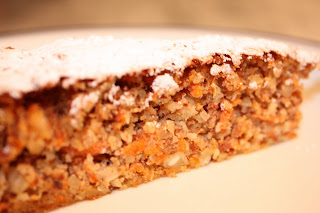
When it comes out of the oven, it doesn't look super pretty


A quick shake of confectioners sugar solves this, but takes you one teensy step away from the healthy part of healthier. I like my desserts a bit pretty so I did it.


As you might expect with a toddler adventure, this one involved some clean-up, but we had so much fun it was well worth it.


The end result was fantastic. My whole family, including the most important voter, my daughter, LOVED it. I brought leftovers into the office, and it got good reviews there, too. This isn't the carrot cake you find in the dessert case at your local diner or coffee shop, but it is a tasty "sometimes treat" you can make with your kid.

Biomedical research to advance human heath


Recent articles call for speeding the translation from discovery and documentation of the human genome and application to clinical medicine and public health. In addition in the New England Journal of Medicine, Moses and Martin 1 identify gaps and opportunities for biomedical research. They note the need for greater collaboration and new models of collaboration in academic medicine (see article). We are pursuing new strategies for transdisciplinary science in teaching and research at Washington University in St Louis (see the Institute for Public Health).

They also note the need for cost-effective targets and new incentives for researchers to focus on diseases that are common. Years ago I wrote on the absence of training in emergency medicine and the common ailments that physicians encounter on a daily basis. Seems to me that not much has changed in our approach to training physicians who can meet the needs of the communities they serve 2.

Finally, they emphasize the need for improved data on clinical value of interventions. They call for physicians and surgeons to commit to a new level of objectivity in judging the clinical value of interventions 1. 

At Washington University School of Medicine the Department of Surgery has created a Division of Public Health Sciences to integrate these quantitative disciplines into the full spectrum of research and training in the department – from bench, to bedside, to community.  The Division Provides a platform for investigators from multiple disciplines to collaborate on innovative projects, it supports an exceptional academic base through education, training and mentoring of students, fellows and faculty and aims to improve the health and wellbeing of people and communities in the St. Louis region and beyond.

The Division of Public Health Sciences is also home to the new Master of Population Health Sciences (MPHS) degree at Washington University that aims to equip clinicians and others with clinical doctorates with the advanced population health research expertise that is necessary for successful careers as independent clinician-researchers. The goal of the MPHS program is to ensure students can transfer and apply the sophisticated population health research methods skills learned in the program throughout their careers. This goal is accomplished in several ways, including:
  • Required quantitative courses – The MPHS program has a unique depth of required quantitative methods courses. The quantitative curriculum emphasizes the role of epidemiology and biostatistics in approaching clinical effectiveness and outcomes research.
  •  Applied coursework – The MPHS does not require a research thesis/capstone. Instead, the program makes innovative use of applied coursework to focus on the long-term application of skills. Using topics relevant to their careers and interests, the applied coursework allows MPHS students to practice the art of developing research study protocols, performing systematic reviews, designing epidemiologic studies and more. By developing these skills across a thematic research area of interest, students are well positioned to apply this knowledge to future studies as their careers advance.
  • Focused concentrations – Three concentration options (Clinical Epidemiology, Health Services and Quantitative Methods) allow students to further hone their population health research skills to match clinical interests.


Literature Cited


Wednesday, February 9, 2011

We're Back - With ENERGY, 8 Ways, and the New Dietary Guidelines

The CNiC team hasn't gone on a month long vacation (though that sure sounds nice with the snow we've had). We're just been busy with writing grants and papers and gearing up for some other exciting things around here. We'll be back with real content shortly, but in the meantime, here are some of what's been occupying us:

Our 8 Ways to Stay Healthy and Prevent Disease is going to be featured in an exciting new partnership with KSDK news beginning next month. I also hope we'll get to highlight our new Cancer Survivors' 8 Ways to Stay Healthy After Cancer.

The USDA released the new Dietary Guidelines. I've enjoyed reading the opinions of my colleagues on these. As our colleagues at AICR have pointed out, the guidelines include some things that are important for cancer prevention, including eating less, eating fruits and vegetables and managing portions. A few other favorites on the guidelines in general:
Michele Simon at Appetite for Profit
Harvard Nutrition Source
and of course,
Marion Nestle
Our ENERGY study is about to start our first wave of women in the weight control program. We are continuing to recruit, as are our colleagues in San Diego, Denver and Birmingham. This is a weight management program for overweight breast cancer survivors.

And I've learned that engaging a toddler in the cooking process, while great on many levels, is not conducive to food photography - and thus, prevention cooking posts!

Thursday, January 27, 2011

Smoking, Breast Cancer, and One More Reason to Keep up the Fight Against Tobacco

It may not fall into the "shocking" category, but a new Harvard study by our colleagues at the Nurses' Health Study has provided further insight into the links between smoking and breast cancer (study).  To date, many studies have had waffling results on the subject.  Some showing smoking raising risk; some showing it not affecting risk at all; and some even showing it lowering risk.

This new study by Xue et al is a longer followup to an earlier Nurses' Health Study report and included over 110,000 women who were tracked over a 30 year period.  The main finding from this study was that smoking likely has some affect on breast cancer risk, but even with heavy smoking, the risk isn't as high as with other cancers linked to smoking (like lung, oral, and esophageal cancer, to name just a few). Greatest risk came from heavy smoking before giving birth to a first child, which raised risk by about 18 percent compared to never smoking.  The broad analysis comparing those who have ever smoked  to those who have never smoked showed a small six percent increase in risk.

Not surprisingly, heavy smoking after menopause showed a small protective effect against breast cancer.  After menopause, blood estrogen levels drive a lot of breast cancer risk, and for multiple reasons, smoking stems estrogen levels, which in turn could lower risk after menopause. Increases in risk, though, from smoking before menopause outpaced any small drop in risk from smoking afterward. 

So what do these results mean?  While there are still some open questions about the link between smoking and breast cancer, they certainly add one more reason to avoid smoking and to support policies that lead to that end.  Adding breast cancer to the list, there are no fewer than 12 different cancers caused by or directly linked to cigarette smoking.  Heart disease, diabetes, stroke, chronic bronchitis, emphysema, osteoporosis, and a number of other important conditions belong on the list as well.  With the decline in US smoking rates stalling - leaving just over 20 percent of the population regular smokers (previous post) - it's important that we keep our guard up against tobacco use.  It's been a long fight, and we've gained a lot of ground, so it's easy to feel that we've done what we can and move on to some new health promotion venue.  But, really, smoking still deserves a great deal of attention. The potential health gains from further lowering smoking rates are huge and should not be downplayed just because we've made some strides and have been working on the issue a long time.

Tuesday, January 25, 2011

Tossing out hypotheses?

It is a good morning exercise for a research scientist to discard a pet hypothesis every day before breakfast. It keeps him young.
-Konrad Lorenz

This week's news brought a story that remind me that sometimes, the best science involves letting go of previously held hypotheses.

Access to quality, health food, particularly fruits and vegetables, is something that has occupied a good deal of news space in recent years. And with good reason. If people can't get healthy food, all the health education in the world telling them to eat it isn't going help. The result has been a lot of attention on food deserts - the lack of supermarkets in certain neighborhoods. How pervasive are these food deserts and what do the food options look like in these areas? Jim Griffioen takes a powerful look at this in his hometown of Detroit over at Urbanophile. He shows, in great detail, the incredible depth and breadth of quality locally owned food purveyors within Detroit. He also points out that a quick Google search locates a number of smaller chain grocery stores. Does Detroit have a Whole Foods or Super Target? No, but Griffioen argues they don't need one. I have been reading his personal blog for some time and one of my favorite series has always been his photos of the family's "haul" from Detroit's Eastern Market. The photos highlight an incredible diversity of delicious looking produce and food that is locally grown or produced. Kudos to Griffioen for pushing journalists and researchers to examine these questions in more detail - and draw new conclusions when the data indicates it.