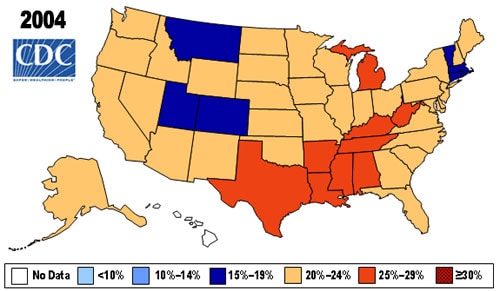
United States, data from 2003-2004 report that 66 percent of adults are overweight or obese (BMI ≥25) and 32 per cent of adults are obese (BMI ≥ 30), with a rising trend since 1988 (Ogden, Carroll et al. 2006). Overweight and obesity cause a substantial proportion of several cancers, including oesophageal, colorectal, endometrial, kidney and postmenopausal breast cancers (International Agency for Research on Cancer 2002). Additional evidence from combining prospective data on up to 6 million men and women shows that overweight and obesity also drive risk of lymphoma, multiple myeloma and advanced prostate cancer (Renehan, Tyson et al. 2008).
Public health recommendations call for adults to stay within the recommended BMI range (18.5-24.9) and avoid weight gain. Accordingly, in its Global Strategy on Diet, Physical Activity, and Health, the WHO identifies energy balance and maintenance of a healthy weight as a public health priority and charges member states to develop and support multisectoral programs to address weight, diet, and physical activity; thereby decreasing noncommunicable disease world wide (World Health Organization 2004).
Programmatic and realistic recommendations include interventions that integrate physical activity and diet for more sustained behaviour change. At the grade school level, Gortmaker and colleagues have successfully integrated approaches to diet, activity, and TV viewing into the school curriculum, achieving a sustained intervention and significant increases in fruit and vegetable consumption, reduction in TV viewing (Gortmaker, Cheung et al. 1999) and in a second study also reducing obesity (Gortmaker, Peterson et al. 1999) . In adult populations, a randomized trial achieved sustained weight reduction over two years through diet and activity interventions by health care providers, and resulted in reduced progression to diabetes among men and women at elevated risk (Knowler, Barrett-Connor et al. 2002).
Whole community interventions are exemplified by one in Belgium that included multiple strategies (media campaign, environmental approaches, use of pedometers, and local projects) and resulted in a significant increase in the proportion of the population achieving a target of 10,000 steps per day (De Cocker, De Bourdeaudhuij et al. 2007).
CDC recommendations for combating overweight and obesity can be found at
http://www.cdc.gov/obesity/recommendations.html. These include community based strategies; school based obesity prevention; and clinical guidelines.
Sugar sweetened beverages
Given the preponderance of evidence that sugar-sweetened beverages increase the risk of obesity and diabetes, a growing number of interventions are now focused on strategies to reduce intake through substitution of other beverages that do not contribute to the excess energy intake. In addition to individual behaviour change, strategies that alter access through limiting on-school campus sale and increasing taxation or removing tax protection may further reinforce behaviour change.
Benefits of weight loss
Because of limited success in achieving sustained weight loss, cancer outcomes have been rarely studied. One important finding from the Nurses’ Health Study shows that weight loss after menopause that is sustained results in a significant reduction in incidence of breast cancer in the short term (Eliassen, Colditz et al. 2006). This is consistent with changes in hormone levels with weight loss. The time course of risk reduction for other cancers or precursor lesions remains to be clarified.
Conclusion
Fifteen to 20 percent of all cancer deaths are due to overweight and obesity; and there is trong evidence that weight loss improves quality of life (Fine, Colditz et al. 1999) and reduces risk of diabetes, heart disease, and stroke. Thus, maintaining a health weight, avoiding further weight gain through the adult years, and reducing weight all are top priorities for cancer prevention. The strong evidence that women who lose weight after menopause significantly reduce their risk of breast cancer adds urgency to our implementing approaches to help women keep weight off after menopause.
Literature cited
De Cocker, K. A., I. M. De Bourdeaudhuij, et al. (2007). "Effects of "10,000 steps Ghent": a whole-community intervention." Am J Prev Med 33(6): 455-463.
Eliassen, A. H., G. A. Colditz, et al. (2006). "Adult weight change and risk of postmenopausal breast cancer." JAMA 296(2): 193-201.
Fine, J., G. Colditz, et al. (1999). "A prospective study of weight change and health-related quality of life in women." JAMA 282: 2136-2142.
Gortmaker, S. L., L. W. Cheung, et al. (1999). "Impact of a school-based interdisciplinary intervention on diet and physical activity among urban primary school children: eat well and keep moving." Arch Pediatr Adolesc Med 153(9): 975-983.
Gortmaker, S. L., K. Peterson, et al. (1999). "Reducing obesity via a school-based interdisciplinary intervention among youth: Planet Health." Arch Pediatr Adolesc Med 153(4): 409-418.
International Agency for Research on Cancer (2002). Weight Control and Physical Activity. Lyon, International Agency for Research on Cancer.
Knowler, W. C., E. Barrett-Connor, et al. (2002). "Reduction in the incidence of type 2 diabetes with lifestyle intervention or metformin." N Engl J Med 346(6): 393-403.
Ogden, C. L., M. D. Carroll, et al. (2006). "Prevalence of overweight and obesity in the United States, 1999-2004." JAMA 295(13): 1549-1555.
Renehan, A. G., M. Tyson, et al. (2008). "Body-mass index and incidence of cancer: a systematic review and meta-analysis of prospective observational studies." Lancet 371(9612): 569-578.
World Health Organization (2004). Global Strategy on Diet, Physical Activity, and Health. Geneva, World Health Organization